






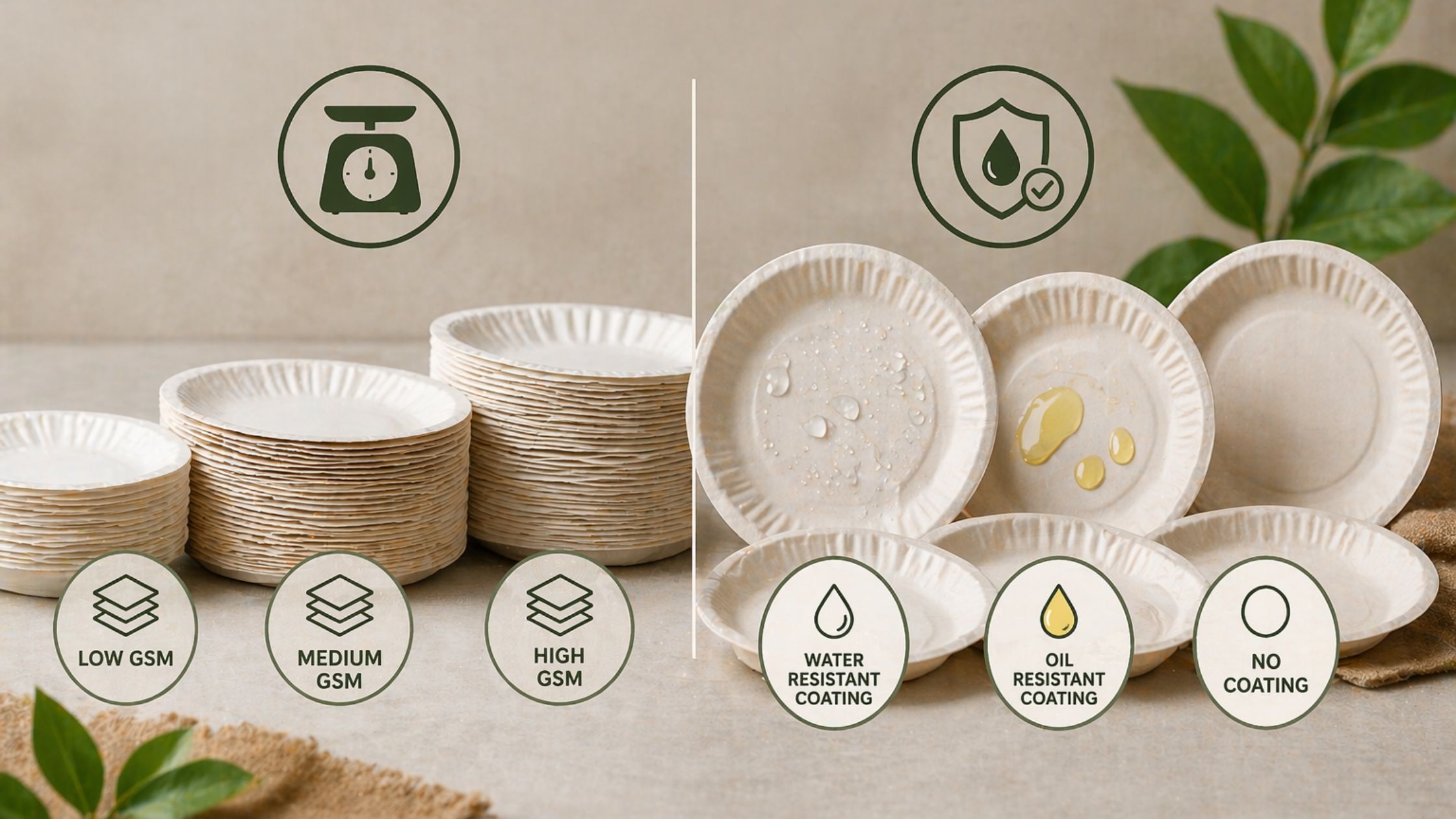
Paper plate quality is determined by two main factors: GSM (Grams per Square Meter), which measures the thickness and rigidity of the paperboard base, and the coating applied to the surface to resist moisture and grease. Economy plates run 150–190 GSM with minimal or wax coating; standard party plates fall at 200–250 GSM with PE or aqueous coating; heavy-duty catering plates are 280–350 GSM with grease-proof PE or PLA coatings. For microwave use, always look for aqueous-coated or microwave-safe labels. Bagasse (sugarcane fiber) plates offer a naturally grease-resistant, chemical-coating-free premium alternative.
Table of contents
- Why Paper Plate Quality Is More Complex Than You Think
- What Is GSM? The Structural Backbone of Every Paper Plate
- Paper Plate Coatings: The Protective Layer That Makes or Breaks Performance
- Physical Construction Factors: The Details That Make the Difference
- How to Choose the Right Paper Plate: The Food-Matching Rule of Thumb
- The Bagasse Alternative: Premium Quality Without the Chemical Coating
- Putting It All Together: How PartySparkz Translates Quality into Retail-Ready Products
- Conclusion: Spec Smart, Source Smart
- Frequently Asked Questions
Why Paper Plate Quality Is More Complex Than You Think
Pick up a paper plate at a supermarket, and you’ll see very little on the label beyond the count and a vague claim like ‘heavy duty.’ But behind every plate is a deliberate engineering decision: a specific paperboard weight, a surface coating chosen for a particular food type, and a physical construction method that determines whether the plate survives a serving of BBQ ribs or buckles under a slice of birthday cake.
For everyday shoppers, getting this wrong means a ruined outfit and an embarrassing moment at a party. For retailers, event planners, caterers, and procurement managers, choosing the wrong plate specification means returns, complaints, and reputation damage. If you are a retailer, then you should pick up Best Paper Plates for Retailers.
This guide breaks down the science behind paper plate quality in plain language. By the end, you’ll understand exactly what GSM means and why it matters, how different coatings affect performance and sustainability, what physical construction factors separate average plates from excellent ones, and how to match plate specifications to food types. We’ll also introduce how PartySparkz translates this technical knowledge into a curated product range that takes the guesswork out of buying.
What Is GSM? The Structural Backbone of Every Paper Plate
GSM stands for Grams per Square Meter. It is the universal measure of paperboard density, essentially telling you how much material is packed into every square meter of the sheet used to make the plate. The higher the GSM, the denser, stiffer, and stronger the plate.
Think of GSM as the ‘skeleton’ of the plate. No matter how good the coating is, a low-GSM plate will flex, sag, and ultimately fail under weight. Understanding GSM weight categories is the single most important step in selecting the right paper plate for any application.
GSM Weight Categories and Their Real-World Use Cases
| GSM Range | Grade | Feel & Strength | Best Use Cases |
| 150 – 190 GSM | Economy / Snack | Floppy and thin; bends easily | Dry snacks (pretzels, chips), cold sandwiches, napkin substitutes |
| 200 – 250 GSM | Standard / Party | Noticeably stiffer; holds shape when lifted by the edge | Cake, pizza, hot dogs, typical party fare |
| 280 – 350 GSM | Heavy Duty / Catering | Buffets, heavy pastas, BBQ, steak, and outdoor catering | Formal outdoor events, standing receptions, and premium gifting |
| 400+ GSM | Luxury / Ultra | Feels like heavy cardstock or thin wood | Formal outdoor events, standing receptions, premium gifting |
150 – 190 GSM: Economy / Snack Grade
At this weight, plates are thin enough to flex noticeably when lifted. They serve one purpose well: holding dry, lightweight foods where structural rigidity is not required. Cold cut sandwiches, chips, cookies, and pastries are well within their capability. However, place anything saucy, heavy, or hot on these plates and problems emerge quickly, often requiring users to ‘double up’ two plates for basic stability.
Retail Note: Economy plates should never be merchandised as general-purpose or party plates. Positioning them clearly as ‘snack’ or ‘napkin plates’ avoids returns and customer disappointment.
200 – 250 GSM: Standard / Party Grade
This is the most commonly stocked weight range in retail. Plates in this range hold their shape when lifted by the rim and comfortably support standard party foods. Birthday cake, pizza slices, hot dogs, and light pasta portions all perform well. The risk zone is heavy sauces and large meat portions. A generous serving of stew or pulled pork may cause visible bowing if the plate lacks adequate coating support.
Best Seller Zone: The 220–240 GSM range with PE or aqueous coating is the single most popular specification across grocery, party supply, and online retail channels.
280 – 350 GSM: Heavy Duty / Catering Grade
This is where paper plates begin to behave like proper dinnerware. The density gives them a reassuring rigidity — plates at this weight can support a full plate of BBQ ribs, a generous portion of pasta, or a thick steak slice without flexing. Many plates in this range incorporate deep-well designs (a raised bottom that contains liquids) and reinforced multiple-pleat rims that actively resist bending under load. Caterers, restaurant-adjacent retailers, and event planners overwhelmingly prefer this range for seated dining.
400+ GSM: Luxury / Ultra Grade
At this density, a paper plate genuinely feels like a premium product; the tactile experience is closer to heavy cardstock or a thin wooden tray than a disposable item. This range exists for formal outdoor occasions: garden parties, corporate events, outdoor receptions, and premium brand activations where guests stand and eat. The quality signal to guests is unmistakable.
PartySparkz wholesale party supplies stocks ultra-grade plates ideal for premium event retailers and gifting applications, available in custom finishes for branded events.
Paper Plate Coatings: The Protective Layer That Makes or Breaks Performance
Without a surface coating, even the densest paperboard plate will absorb grease and moisture from food, becoming soft and structurally compromised within minutes. The coating is the ‘skin’ of the plate it determines how well the plate resists liquid penetration, whether it is safe to microwave, how it performs with hot food, and what happens to it at the end of life.
Understanding coating technologies is essential for anyone sourcing plates, especially as sustainability regulations and consumer preferences increasingly favour specific coating types over others.
| Coating Type | Material | Performance | Microwave Safe? | Sustainability |
| Wax (Paraffin/Soy) | Petroleum or soy wax | Good for cold/dry food; melts on contact with hot food | ❌ No — melts & leaches | Biodegradable but not recyclable |
| PE (Polyethylene) | Standard plastic film | Excellent moisture/grease barrier; handles heat well | ⚠️ Conditional only | Non-recyclable; stays in landfill |
| PLA (Polylactic Acid) | Corn starch / plant-based | Good grease resistance; looks like plastic | ⚠️ Check label | Compostable in industrial facilities only |
| Aqueous (Water-based) | Polymer dispersion | Excellent heat resistance; smooth matte finish | ✅ Yes — safest option | Best for recycling; breaks down like plain paper |
| Clay (Kaolin) | Natural mineral coating | Smooth surface for vivid printing; slight rigidity boost | ✅ Yes | Safe and natural; no chemical concerns |
Wax Coating (Paraffin or Soy)
Wax is the oldest coating technology in paper plate manufacturing. It creates a basic moisture barrier that performs adequately for cold, dry applications — think birthday cake on a napkin plate or cold cuts at a casual gathering. However, wax has a critical limitation: it melts. Place a hot dish on a wax-coated plate and the coating begins to soften and potentially migrate into the food. Soy wax variants are a marginally greener option (plant-based vs. petroleum), but the performance limitation remains the same.
Wax-coated plates are biodegradable but cannot be recycled because the wax contamination disqualifies them from paper recycling streams.
PE (Polyethylene) Coating
Polyethylene is currently the most widely used coating in mainstream retail paper plates. It provides an excellent moisture and grease barrier, handles heat well (within limits), and is cost-effective at scale. Brands like Dixie Ultra use PE-based coatings as part of their soak-proof shield technology. The significant downside is environmental: PE-coated plates are non-recyclable in virtually every municipal recycling system and persist in landfills for decades. As sustainability regulations tighten, particularly in the EU and California, PE coating is increasingly under scrutiny.
Retailer Alert: Several US states and EU markets are introducing restrictions on single-use plastic coatings on food packaging. If you source PE-coated plates for retail, monitor legislative developments in your key markets.
PLA (Polylactic Acid) Coating
PLA is derived from fermented plant starches (typically corn) and is marketed as a sustainable alternative to PE. It provides good grease resistance and is visually similar to plastic film. The ‘compostable’ claim requires an important qualification: PLA breaks down only in industrial composting facilities operating at specific high temperatures. Home composting bins do not get hot enough. Retailers should ensure PLA product packaging clearly communicates this distinction to avoid consumer confusion and greenwashing complaints.
Aqueous (Water-Based) Coating
Aqueous coating is increasingly considered the gold standard for both performance and sustainability. Applied as a water-based polymer dispersion, it creates excellent heat resistance, a smooth matte finish, and critically, it breaks down during the paper recycling process like plain paper. Plates coated with aqueous technology are the safest choice for microwave use and are compatible with recycling infrastructure. Look for this coating in premium brands and eco-oriented product lines.
Clay (Kaolin) Coating
Clay coating using kaolin (a naturally occurring mineral) is primarily a print-performance coating rather than a moisture barrier. It creates an ultra-smooth, bright white surface that allows for vivid, high-resolution printing, making it popular for branded, themed, and decorated paper plates where visual presentation matters. It adds a slight structural rigidity and is entirely safe and natural. Clay-coated plates are typically used in combination with a moisture-barrier coating for food-contact applications.
PartySparkz Note: PartySparkz’s seasonal and themed plate ranges use clay-coated surfaces for print quality combined with aqueous moisture barriers — delivering both vivid designs and responsible materials.
Physical Construction Factors: The Details That Make the Difference
GSM and coating get most of the attention, but the way a plate is physically formed has a significant impact on real-world performance. Two plates with identical GSM and coating can behave completely differently depending on their construction method.
Rim Strength: Multi-Pleat vs. Flat-Rimmed
The rim is where plates most commonly fail under load. When you hold a plate by the edge, and the food pushes down on the center, the rim bears the bending stress. Plates with a ‘multi-pleat’ rim, where the paper is folded and crimped multiple times around the circumference, distribute this stress far more effectively than a simple flat rim. Deep-embossed rims that create a raised channel around the plate perimeter add further rigidity. For any plate expected to carry wet or heavy foods, rim construction is as important as GSM.
Ply Count: Single-Layer vs. Multi-Ply
Some premium plates use multi-ply construction, laminating two or more thinner sheets of paperboard together rather than using a single thick sheet. Multi-ply plates typically offer better burst strength (resistance to puncture from sharp food items like bones or skewers) and improved flexibility-rigidity balance. They can feel slightly different to the hand, more ‘springy’ rather than stiff, while performing better under impact loading.
Lamination vs. Coating: An Important Distinction
These two terms are sometimes used interchangeably, but they represent different manufacturing processes with different performance and sustainability implications. Lamination involves physically bonding a separate film layer to the paperboard surface stronger initial barrier, but prone to delamination (peeling) at cut edges or under prolonged moisture exposure. Coating involves spraying or rolling a liquid barrier material directly onto the surface. The result is a more integrated, less prone to peeling, but potentially a thinner barrier. Most recycling-compatible plates use coating rather than lamination.
Expert Insight: When evaluating plates for catering or high-volume event use, request samples and perform a simple ‘sauce test’ — place a tablespoon of tomato sauce or gravy on a plate and leave for five minutes. A well-constructed plate should show no bleed-through or softening.
How to Choose the Right Paper Plate: The Food-Matching Rule of Thumb
The most practical way to select a paper plate specification is to match it to the heaviest, wettest, or most demanding item that will be served. Here’s a straightforward decision guide:
| Food Category | Recommended GSM | Best Coating | Examples |
| Dry / Light | 180 GSM | None or Wax | Popcorn, cookies, crackers, cold sandwiches |
| Oily / Standard | 240 GSM | PE or Aqueous | Pizza, tacos, fried chicken, hot dogs |
| Wet / Heavy | 300+ GSM | PE or PLA (grease-proof) | Pasta, stew, BBQ, curry, chili |
| Microwaving | 240+ GSM | Aqueous only | Reheated leftovers, soup, sauced dishes |
| Formal Events | 350–400+ GSM | Aqueous or Clay | Seated receptions, buffet stations, VIP events |
The Rule of Thumb: Always spec to the hardest item on the menu, not the average. One soft taco is fine on 200 GSM — but if you’re also serving pulled pork, the pulled pork determines the spec for the whole event.
The Bagasse Alternative: Premium Quality Without the Chemical Coating
For buyers who need maximum structural performance combined with genuine environmental responsibility, bagasse — the fibrous residue left after sugarcane juice is extracted — offers a compelling alternative to traditional paper plates.
- Naturally Heavy Duty: Bagasse plates are equivalent in performance to 300+ GSM paper plates due to the inherent density of sugarcane fiber. They do not require high GSM paperboard because the fiber itself provides rigidity.
- No Chemical Coating Required: Sugarcane fiber is naturally oil and grease-resistant. Bagasse plates require no PE, PLA, or wax coating to resist moisture — eliminating the sustainability concerns associated with plastic coatings.
- Fully Home-Compostable: Unlike PLA-coated plates (which require industrial composting), bagasse plates break down in home compost bins and standard composting environments. This is a genuine, verifiable sustainability claim.
- PFAS-Free by Default: Because no coating is applied, bagasse plates carry no risk of PFAS (per- and polyfluoroalkyl substances) exposure — increasingly important as health-conscious consumers scrutinize food contact materials.
PartySparkz’s eco range includes BPI-certified bagasse plates available in multiple sizes, ideal for retailers targeting the growing PFAS-aware, sustainability-focused consumer segment.
Putting It All Together: How PartySparkz Translates Quality into Retail-Ready Products
Understanding GSM, coatings, and construction is genuinely useful, but translating that knowledge into a reliable wholesale order requires a supplier who has already done the technical curation for you. That’s precisely what PartySparkz is built for.
PartySparkz is a wholesale and retail supplier of disposable tableware and party supplies, purpose-built for retailers, event businesses, and procurement teams. Every product in the PartySparkz paper plate catalog is selected against defined quality benchmarks, GSM rating, coating type, construction method, and sustainability credentials, so buyers can order with confidence rather than guesswork. With retail-ready packaging, flexible MOQs, and a range spanning economy through luxury tiers, PartySparkz simplifies the sourcing decision from a complex technical exercise into a straightforward conversation about your customer and their menu.
What Type Of Paper Plates Does PartySparkz Provide?
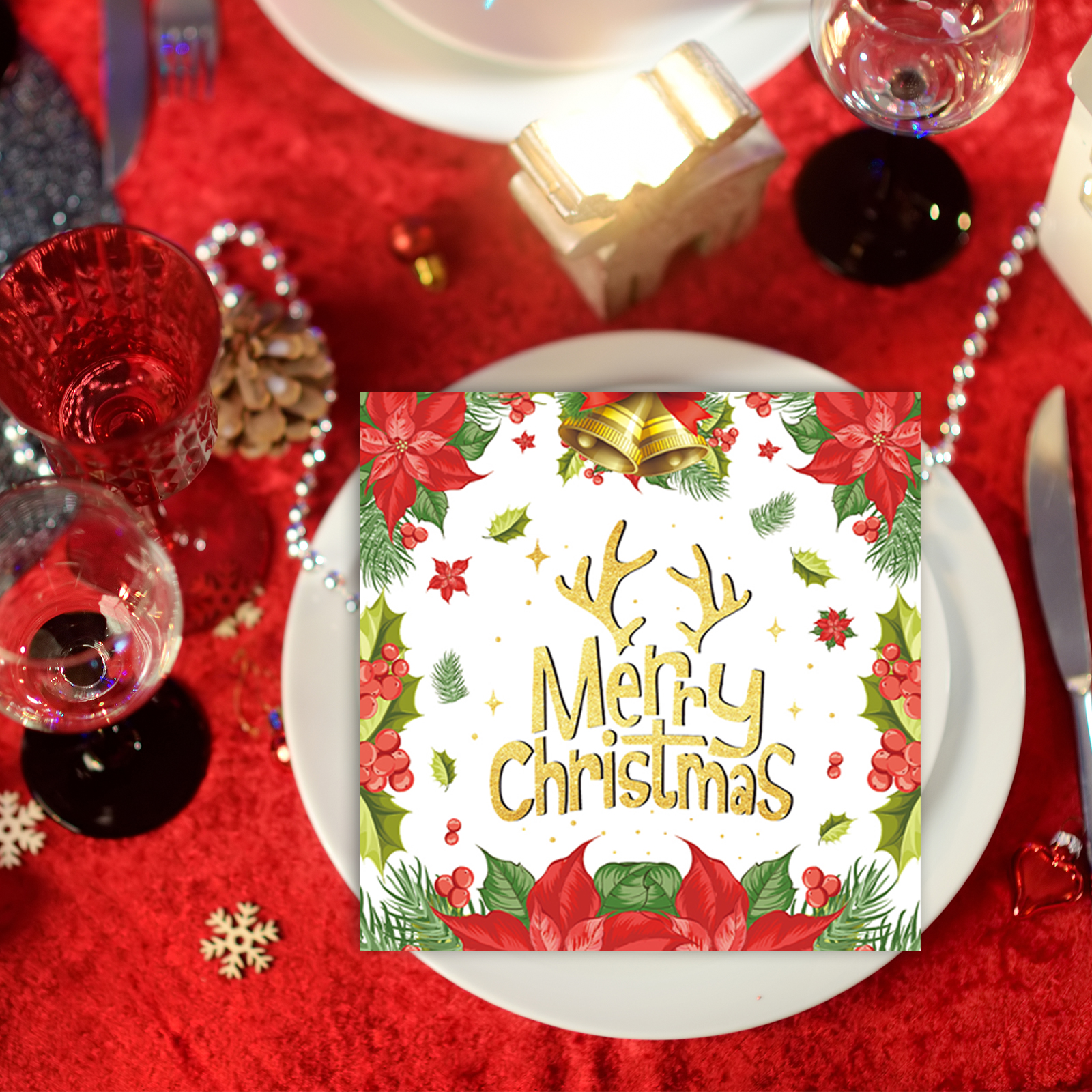
- Christmas paper plates
- Independence Day Paper Plates
- 4th Of July Paper Plates
- easter paper plates
- easter paper plates, vibrant colors
- Thanksgiving Paper Plates
PartySparkz Paper Plate Range by Quality Specification
| Product Tier | GSM Range | Coating Type | Eco Status | Ideal Retail Channel |
| Economy Snack Plates | 160–190 GSM | Wax / Uncoated | Biodegradable | Dollar stores, discount retail |
| Standard Party Plates | 220–250 GSM | Aqueous / PE | Recyclable option | Grocery, party supply, mass retail |
| Heavy Duty Catering | 300–350 GSM | PE / Aqueous | Aqueous = recyclable | Restaurant supply, event wholesalers |
| Eco Bagasse Plates | 300+ GSM equiv. | No coating needed | BPI compostable, PFAS-free | Eco shops, natural food, online |
| Luxury Ultra Plates | 400+ GSM | Aqueous / Clay | Premium sustainable | Premium retail, gifting, events |
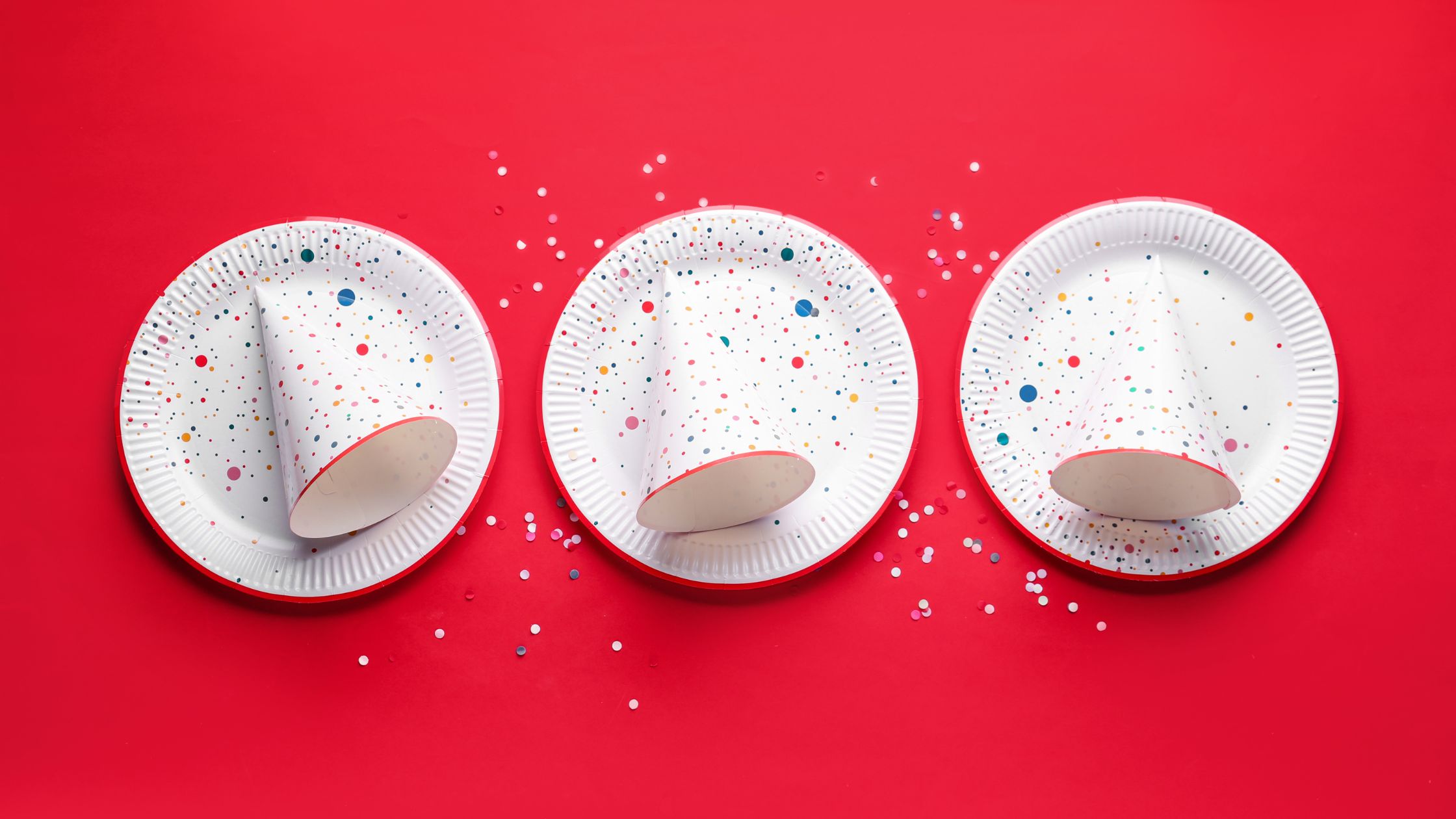
| Seasonal & Themed | 220–280 GSM | Clay + Aqueous | Recyclable | Party stores, seasonal, gifting |
PartySparkz Wholesale Advantages: Specifications verified per batch • GSM and coating type clearly labelled on all trade listings • Aqueous-coated and bagasse options for sustainability-focused retailers • Flexible MOQs for small independents and large chains alike • Seasonal and event-themed ranges refreshed quarterly
Conclusion: Spec Smart, Source Smart
Paper plate quality is the result of three interacting factors working together: the GSM weight of the paperboard base, the coating technology applied to its surface, and the physical construction of the rim and ply structure. Getting this combination right for your specific application or your customers’ needs makes the difference between a product that performs and one that disappoints.
The practical takeaway is straightforward: match your GSM to the weight and wetness of the food, choose your coating based on heat requirements and sustainability goals, and look for rim construction details on any plate intended for heavy-duty or catering use. When in doubt, always spec up rather than down.
PartySparkz has done this technical curation across every tier from 160 GSM economy snack plates to 400+ GSM luxury grades and PFAS-free bagasse options, so you can source the right plate for your customers without needing a materials engineering degree.
Frequently Asked Questions
What is a ‘heavy-duty’ paper plate?
Heavy-duty paper plates typically start at 280 GSM and go up to 350 GSM. At this weight range, plates are rigid enough to support wet, heavy foods like BBQ, pasta, or stew without flexing. Many catering-grade heavy-duty plates also feature multiple-pleat rims and deep-well construction for added stability.
Are paper plates with PE coating safe to use?
PE-coated paper plates are considered food-safe within normal use parameters. The primary concerns are environmental (non-recyclable, long landfill persistence) rather than food safety. For microwave use, PE coating is not recommended as it can soften at high temperatures — opt for aqueous-coated plates labeled ‘microwave safe’ instead.
What is the most environmentally friendly paper plate?
Bagasse (sugarcane fiber) plates without chemical coatings are widely considered the most sustainable option — they are naturally grease-resistant, PFAS-free, and fully home-compostable. Among traditional paper plates, aqueous-coated options are the best choice as they are compatible with paper recycling streams. Avoid PE-coated and wax-coated plates if sustainability is a priority.
Can I microwave food on a paper plate?
Yes, but only on plates explicitly labeled ‘microwave safe.’ Aqueous-coated plates are the safest for microwave use. Avoid wax-coated plates (wax melts), PE-coated plates (may soften and leach), and any plate with metallic printing. When in doubt, check the packaging — reputable suppliers clearly mark microwave compatibility.
What does ‘multi-pleat rim’ mean on a paper plate?
A multi-pleat rim refers to the manufacturing process of folding and crimping the paper multiple times around the circumference of the plate. This creates a reinforced edge that distributes bending stress far more effectively than a flat rim. Plates with multi-pleat rims are significantly harder to bend or collapse when held by the edge under load.
Is 200 GSM strong enough for a party?
For typical party foods — cake, pizza, sandwiches, light snacks — 200–220 GSM with an aqueous or PE coating is adequate. If the menu includes heavy sauces, large meat portions, or wet dishes, step up to 250–280 GSM to ensure plates hold up reliably throughout the event.