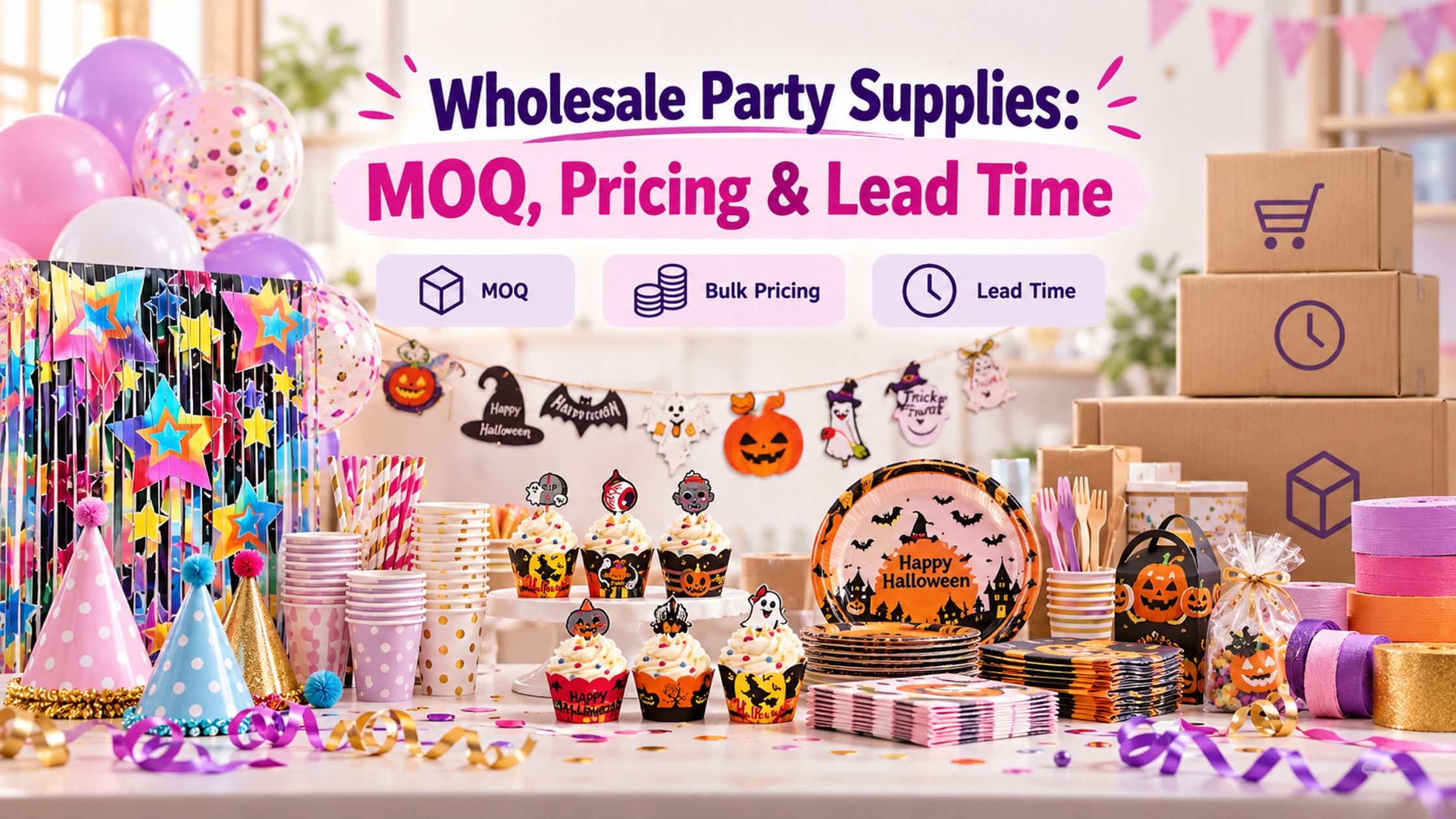
Wholesale party supplies MOQ – Most wholesale party supplies carry a minimum order quantity (MOQ) of a few hundred to a few thousand pieces per design. Production usually takes 15 to 30 days after you approve the order. The number that decides whether stock reaches your shelves in time is the total from order to shelf. For sea freight from China, that often runs two and a half to three and a half months.
This guide is for retailers, distributors, event planners and online sellers placing bulk orders with a party supplies factory.
Key takeaways – Wholesale Party Supplies MOQ
- An MOQ is usually set per design, print or color, not per order. Always ask which one applies.
- Some MOQs are counted in bags or cartons, not pieces. “40 bags” of a 50-piece pack is 2,000 balloons.
- Unit price falls as quantity rises because one-time setup costs are spread over more pieces. The drop slows sharply after the first few thousand units.
- The price on a quote is not what you pay per unit. Freight, duty and packaging choice can change your landed cost significantly.
- Standard production of 15 to 30 days is only one part of the wait. Flexport’s tracker put the median time from factory to leaving a US East Coast port at 66 days in August 2026.
- For Easter 2027 stock, plan for production to finish before Chinese New Year slows factories in January. That means ordering by early November 2026.
Table of contents
- Key takeaways – Wholesale Party Supplies MOQ
- What does MOQ mean for wholesale party supplies?
- Is the MOQ per order, per design or per color?
- Why some MOQs are counted in bags, not pieces
- How does order size change the unit price?
- A rule of thumb from sourcing forums
- What else goes into the price you actually pay?
- How long does production take?
- How long until the goods reach your warehouse?
- When should you order for your next selling season?
- How can you order less than the MOQ?
- Questions to ask a supplier before your first bulk order
- Planning your first order
- Frequently asked questions – wholesale party supplies MOQ
What does MOQ mean for wholesale party supplies?
MOQ is the smallest quantity a factory will produce for one item in a single order. It exists because every production run has fixed costs before the first good unit comes off the line. Those costs include printing plates, machine setup, color matching, test runs and packaging setup.
For party supplies, MOQs fall into three rough bands:
| MOQ band | Typical quantity per item | Who it suits |
| Low | 50–200 pieces | Test orders, new online stores, trend items |
| Mid | 200–1,000 pieces | Party shops, regional distributors, seasonal retailers |
| High | 1,000–5,000+ pieces | Supermarket chains, national distributors, private label brands |
Plain stock items, such as solid-color latex balloons, sit at the low end. Custom-printed tableware, custom foil shapes and private label packaging sit at the high end, because each needs its own setup.
At PartySparkz, custom and OEM orders start from 500 pieces, and in-stock white-label items start from 50 sets. Each product page lists its own MOQ: for example, 50 sets for party glasses and 100 sets per design for LED lights. See the bulk order page for current terms.
Is the MOQ per order, per design or per color?
Usually per design, and often per color or size within that design. This is where many first-time buyers get caught out.
Say a supplier lists an MOQ of 500 pieces for a printed paper plate. If you want it in pink, blue and gold, you may need 500 of each, which makes 1,500 plates. Other suppliers let you mix colors within one MOQ. The listing rarely says which rule applies, so ask before you plan your budget. At PartySparkz, MOQs are set per product design, and mixed orders across categories are accepted. A buyer can combine balloons, tableware and decorations in one order, as long as each design meets its own minimum.
The same question applies to:
- Sizes. Twelve-inch and eighteen-inch versions of the same balloon are separate items.
- Number and letter balloons. Check whether 0–9 counts as one design or ten.
- Mixed themes. A “birthday set” of plates, cups and napkins may carry one MOQ per component.
Why some MOQs are counted in bags, not pieces
Many balloon and tableware MOQs are listed in bags or cartons. Read the pack size next to the MOQ before comparing suppliers.
Two foil balloon lines on the PartySparkz foil balloons page show the difference:
| Listing | Pack size | Pieces at MOQ |
| MOQ 100 bags | 1 piece per bag | 100 balloons |
| MOQ 40 bags | 50 pieces per bag | 2,000 balloons |
The second MOQ looks smaller but is twenty times the volume. Single-piece bags suit retail display. Fifty-piece bags suit decorators and event planners who use balloons by the arch, not by the unit.
Must read –
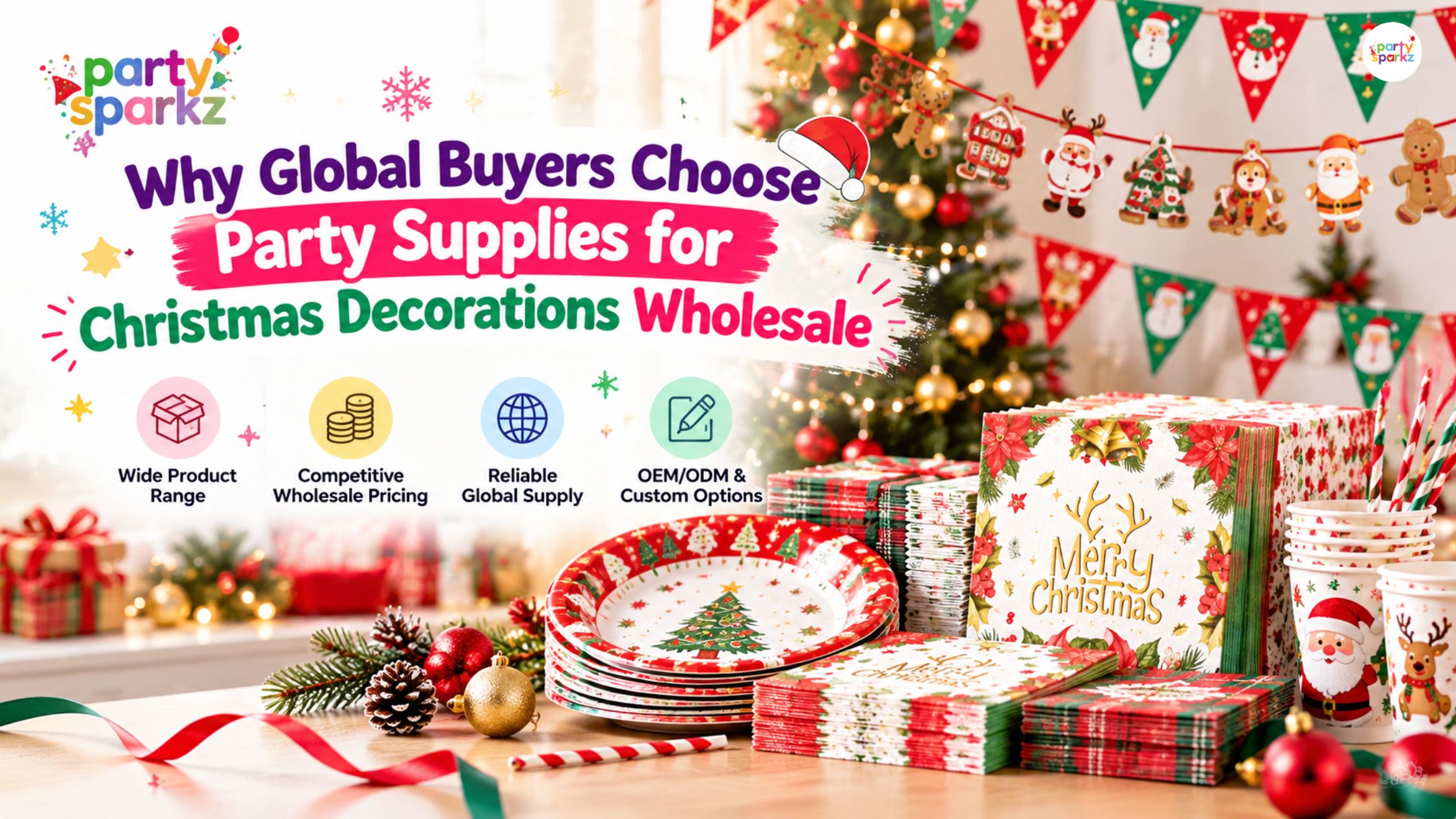
Why Global Buyers Choose Party Supplies for Christmas Decorations
How does order size change the unit price?
Unit price drops as quantity rises because the factory’s one-time setup cost is split across more pieces. After a few thousand units, the setup share becomes tiny and the price levels off near the cost of materials and labor.
Here is an illustration using made-up figures, not PartySparkz prices. Take a custom-printed foil balloon with a US300setupcost(artwork,printingplates,testrun)andUS0.40 in materials and labor per piece:
| Order quantity | Setup cost per piece | Unit cost before margin |
| 300 pieces | US$1.00 | US$1.40 |
| 500 pieces | US$0.60 | US$1.00 |
| 1,000 pieces | US$0.30 | US$0.70 |
| 3,000 pieces | US$0.10 | US$0.50 |
| 10,000 pieces | US$0.03 | US$0.43 |
Going from 500 to 1,000 pieces cuts the unit cost by 30%. Going from 3,000 to 10,000 cuts it by only 14%, while you hold more than three times the stock. That second jump rarely pays off for a seasonal item you may not sell through.
Plain stock items have little or no setup cost, so their price moves less with quantity. That is why solid-color latex balloons often come with low MOQs, while custom-printed designs do not. PartySparkz product pages show a starting price for each item. Prices for larger quantities and custom versions are quoted per order, so send your quantities through the bulk order form to see the price at each volume.
A rule of thumb from sourcing forums
Buyers in sourcing communities on Reddit often repeat a simple trade-off. Of good quality, low price and low MOQ, you can usually have two:
- Good quality and a low price usually means a high MOQ.
- Good quality and a low MOQ usually means a higher unit price.
- A low price and a low MOQ usually means the quality has been cut somewhere.
It is a rough rule, not a law, but it explains most of the quotes you will see.
What else goes into the price you actually pay?
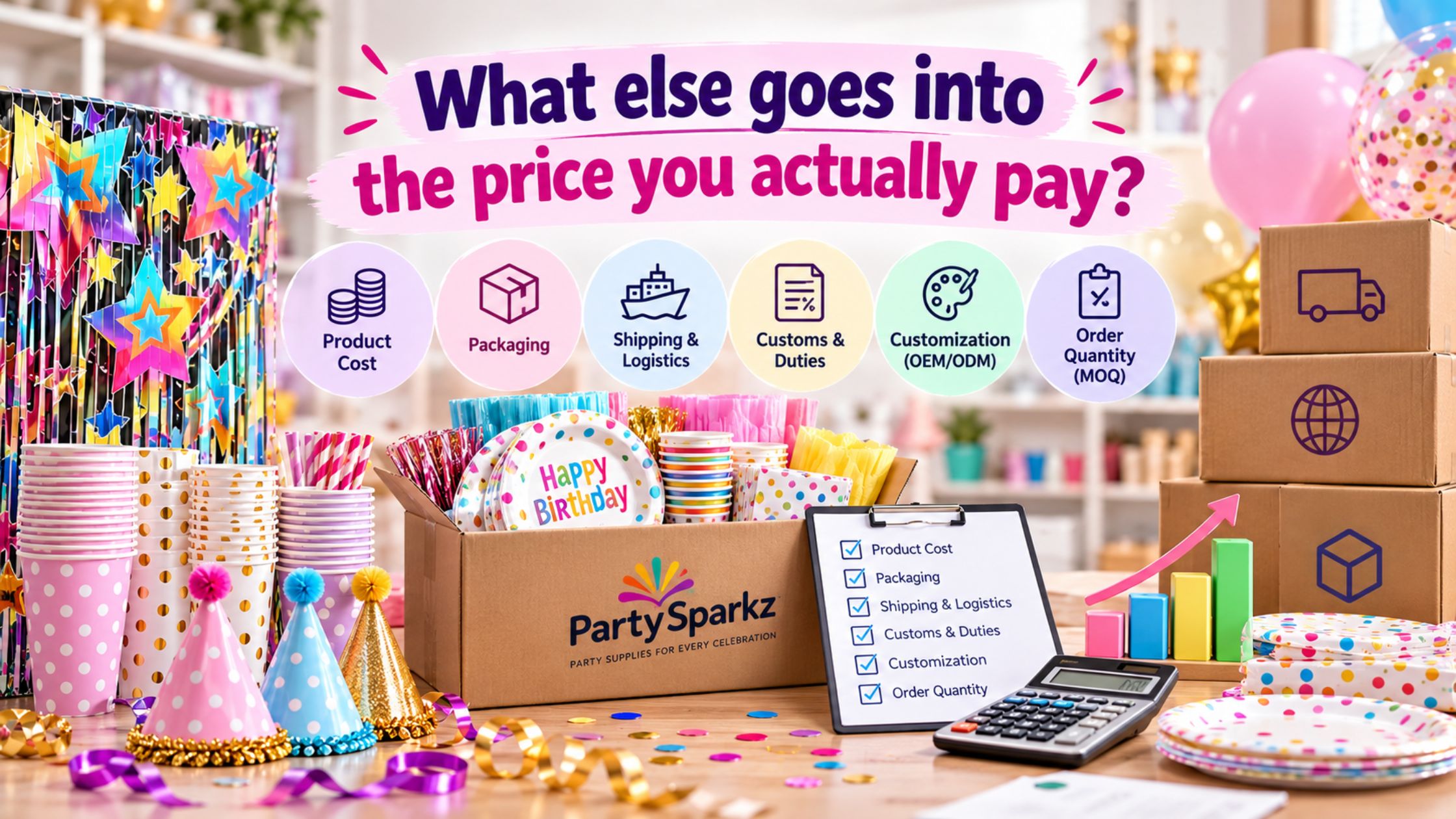
The factory quote covers the product. Your landed cost per unit also includes:
- Packaging choice. Retail-ready packs with headers or printed boxes cost more than bulk bags, but save you repacking labor.
- Shipping terms. An FOB quote stops at the Chinese port. CIF adds sea freight and insurance to your destination port. DDP includes import duty and delivery to your door. PartySparkz states the shipping terms and HS codes on its proforma invoice, and buyers with their own freight forwarder can book shipments under FOB or Ex-Works terms.
- Freight. Balloons are light. Plates, cups and boxed decorations take up space, so freight is often charged by volume rather than weight.
- Import duty. This depends on the product’s HS code and your country. US duties on Chinese goods have changed several times since 2025, so check the current rate before you commit.
- Samples and artwork changes. Some suppliers credit sample fees against the first order. Ask.
Compare suppliers on landed cost per sellable unit, not on the quoted price. A quote that is US$0.05 cheaper per unit on FOB terms can end up more expensive than a DDP quote once freight and customs brokerage are added.
How long does production take?
Standard production for party supplies takes 15 to 30 days from order confirmation to goods packed and ready to ship. At PartySparkz, standard orders take 15 to 25 days, and OEM or custom orders need an extra 10 to 15 days for artwork, sampling and setup. Some lines are quicker: standard LED party lights take 10 to 20 days, depending on quantity and design.
A typical 15–30 day run breaks down like this:
- Order confirmation and materials: 2–5 days
- Production and in-line quality checks: 10–20 days
- Packing, labeling, final inspection and export documents: 3–5 days
Custom and private label orders add time before production starts. Budget one to two weeks for artwork approval and a pre-production sample, and more if you revise the design.
These things push lead time past 30 days:
- Custom color matching. Hitting an exact Pantone shade on latex or foil can take extra test runs.
- Peak season. Factories are busiest from July to September, when Halloween and Christmas orders overlap.
- Chinese public holidays. National Day (1–7 October) pauses most production for a week. Chinese New Year falls on 6 February 2027. Planning guides from logistics firms estimate two to four weeks of lost output around it, with a slow restart as workers return.
How long until the goods reach your warehouse?
Production time is only half the wait. Freight forwarders usually quote port-to-port sea transit from China of roughly 18–25 days to the US West Coast and 30–40 days to the East Coast.
Real-world timing is longer. Flexport’s Ocean Timeliness Indicator measures from the day cargo is ready at the factory to the day it leaves the destination port. In mid-August 2026, its median was:
| Route | Factory-ready to leaving destination port (median) |
| China to US West Coast | 37.6 days |
| China to North Europe | 57.6 days |
| China to US East Coast | 66.1 days |
The gap between the two sets of numbers is waiting for a vessel, port handling and customs. These figures change weekly, so check the current tracker when you plan. Add another week or two for trucking to your warehouse and receiving.
When should you order for your next selling season?
Work backward from the date the stock must be on your shelf:
Order date = shelf date − inland delivery − factory-to-port time − production − artwork and sample approval
Using 10 days for inland delivery, the Flexport medians above, 30 days of production and 14 days for artwork approval gives these latest order dates for custom products:
| Selling season | Destination | Stock on shelf by | Place custom order by |
| Valentine’s Day 2027 | US West Coast | 5 January 2027 | Early October 2026 |
| Easter 2027 (28 March) | US West Coast | 1 March 2027 | Mid-November 2026 |
| Easter 2027 (28 March) | Europe | 1 March 2027 | Early November 2026 |
| Halloween 2027 | US East Coast | 1 September 2027 | Early May 2027 |
| Christmas 2027 | US East Coast | 1 November 2027 | Early July 2027 |
| Christmas 2027 | US West Coast | 1 November 2027 | Early August 2027 |
The Easter rows matter most right now. Goods for Easter 2027 need to be finished before factories slow down in mid-January for Chinese New Year. An order placed in December risks sitting half-made until late February.
For seasonal ranges such as Halloween and Thanksgiving party tableware, many buyers split the order. They send a core quantity by sea early, then top up best-sellers by air once early sales show what is moving.
How can you order less than the MOQ?
Most factories will move on MOQ for a buyer who looks like a repeat customer. These approaches work more often than asking for a discount on its own:
- Start with stock designs. Order plain or existing printed designs first, and add your own label or header card. Custom printing can come on the second order.
- Ask for a trial order with a stated follow-up. For example: 200 pieces now, then 1,000 once you confirm sell-through. Put the follow-up quantity in writing.
- Pay a higher unit price. A small run can often go ahead if you cover more of the setup cost per piece.
- Consolidate designs. Fewer colors or sizes lets each one reach the MOQ.
- Combine categories. A supplier that also makes cake decorations and tableware may accept a smaller quantity per item when the total order is larger.
Questions to ask a supplier before your first bulk order
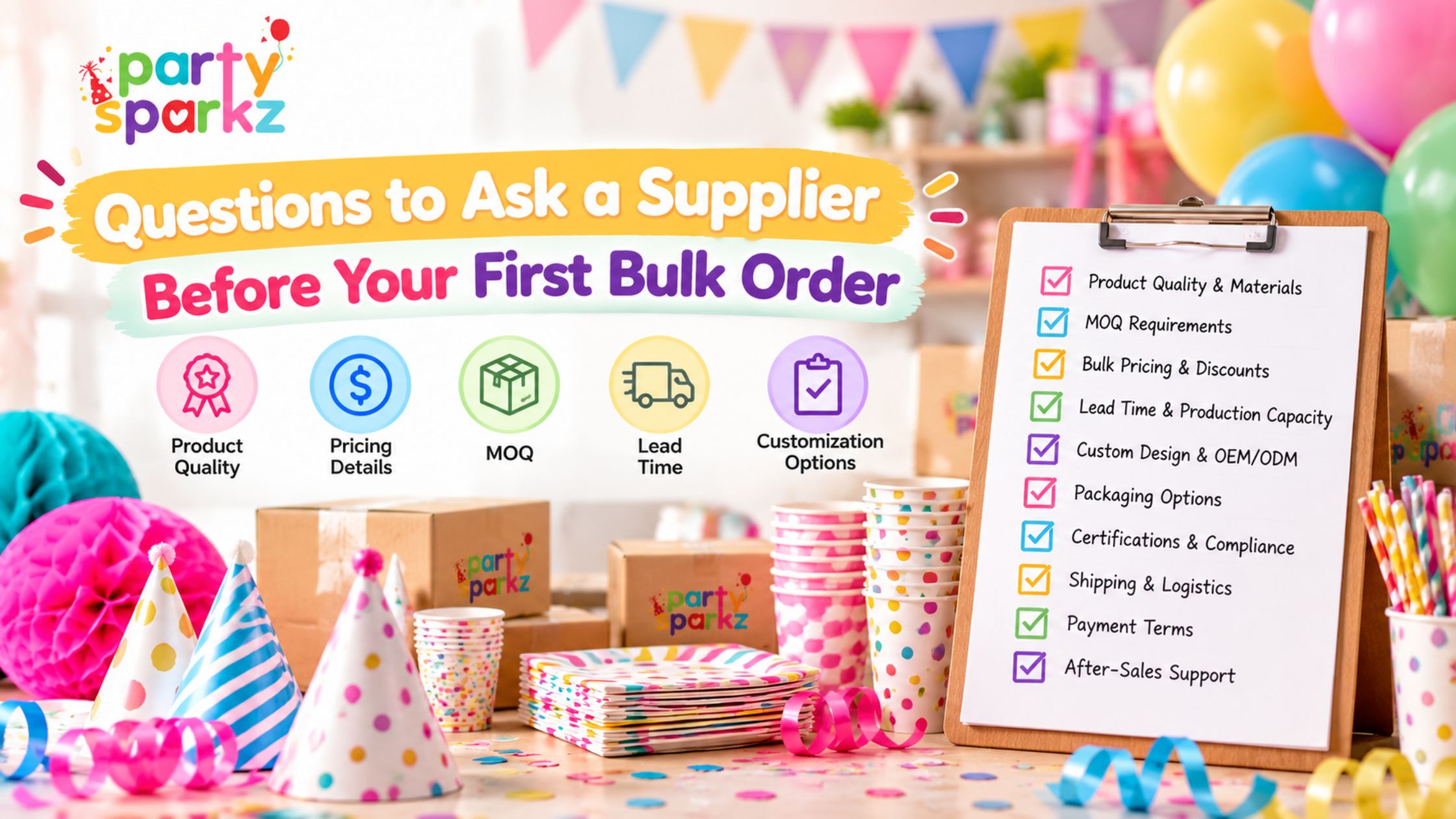
- Is the MOQ per design, per color, per size or per order?
- Is the MOQ counted in pieces, bags or cartons, and how many pieces are in each?
- What are the price breakpoints (for example, 500, 1,000 and 3,000 pieces)?
- How many days is production for stock items, and for custom items?
- When does the lead time clock start: on deposit, on artwork approval or on sample approval?
- What does a pre-production sample cost, and is it credited against the order?
- Which shipping terms can you quote: FOB, CIF or DDP?
- What are your production cut-off dates before National Day and Chinese New Year?
- Which safety standards do your products meet for my market? PartySparkz holds Sedex, BSCI and FAMA factory audits. Product test reports depend on the item and the destination market.
Put the answers in the purchase order. A lead time agreed only in chat is hard to hold anyone to.
Planning your first order
Start with the date stock must be on your shelf, and count backward. Then ask how the MOQ is counted and compare suppliers on landed cost, not on quoted price.
To get MOQs, price tiers and production times for specific items, browse the PartySparkz wholesale party supplies range or send your quantities through the bulk order form. The team replies within 24 hours.
Frequently asked questions – wholesale party supplies MOQ
Custom-printed latex and foil balloons usually start in the hundreds to low thousands of pieces per design, because each print needs its own setup. Plain stock balloons often have lower MOQs.
For custom products, yes, almost always, because the setup cost is split over fewer pieces. For plain stock items, the difference is usually small.
No. Lead time usually means production only, ending when goods are packed at the factory. Delivery time adds ocean or air freight, port handling, customs and inland transport.
Yes. Air freight from China to the US typically takes about a week door-to-door, but costs several times more than sea freight. It works best for light, high-margin items such as foil balloons, and for small top-up orders.
For sea freight to the US East Coast, place custom orders by early July. For the West Coast, place them by early August. After that, rely on stock designs or air freight.