
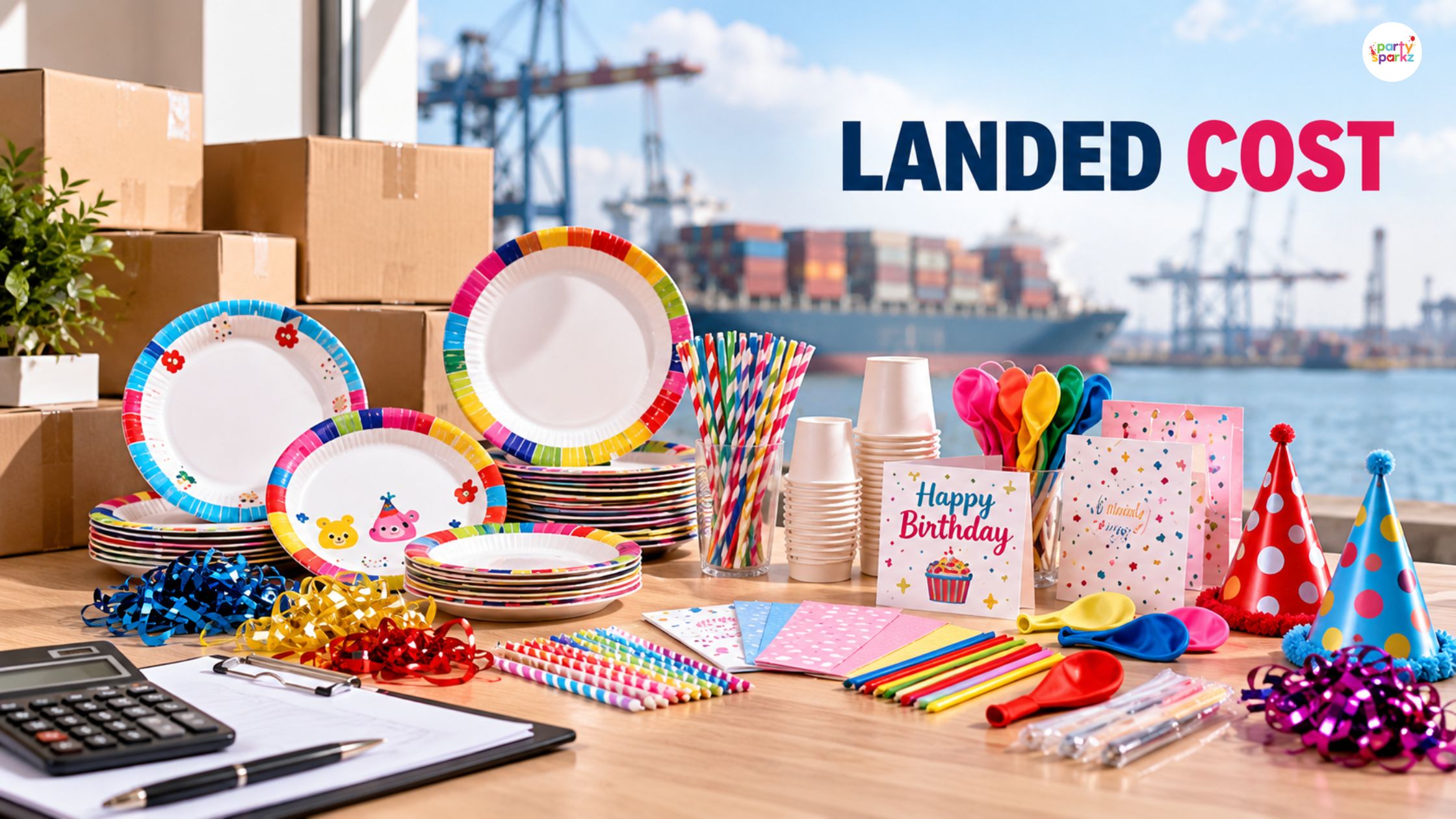
How to calculate landed cost? Landed cost is your product’s true cost once it reaches your warehouse: the supplier’s price plus freight, insurance, customs duty, government fees, and broker charges. For party supplies specifically, a $2 balloon garland can easily land at $2.80 to $3.20 once every cost layer is added, a 40 to 60% markup over the quoted price that catches a lot of first-time importers off guard.
Here’s the full formula, the party-supplies-specific classification details, and a worked example with current rates.
Table of contents
The landed cost formula
Landed cost = Product cost + Freight + Insurance + Customs duty + Government fees + Broker fees + Inland delivery
Every one of these components matters. Budgeting only for product cost and freight, the 2 numbers a supplier usually quotes, is the most common reason importers get an unpleasant surprise at customs.
1. Product cost
The price you pay your supplier, typically quoted FOB (Free On Board) from the Chinese port. This is your starting number, not your landed cost.
2. Freight
Ocean freight for party supplies (lightweight, high-volume goods like balloons, banners, and decorations) is usually quoted per container (FCL) or per cubic meter (LCL, less than container load). LCL costs more per unit but makes sense for smaller orders that don’t fill a full container.
Air freight is faster but substantially more expensive per kilogram, generally only worth it for urgent restocks or high-value, low-weight items.
3. Insurance
Cargo insurance is commonly priced around 0.3 to 0.5% of the shipment’s declared value. It’s often skipped on small shipments, but a total loss on an uninsured container is a real risk, not a hypothetical one. A reasonable rule of thumb from the freight industry: insure any shipment valued over $10,000.
4. Customs duty and the party supplies HTS classification
Most party supplies and decorations fall under HTS heading 9505, “Festive, carnival or other entertainment articles,” covering items like party decorations, banners, and novelty items. Balloon-based toy items or sets can sometimes fall under heading 9503 instead, depending on their specific composition; classification is genuinely product-specific here, not a single blanket code for “party supplies.”
Duty calculation for China-origin goods typically stacks multiple layers:
- Base MFN duty rate, which varies by the specific HTS subheading
- Section 301 tariffs, additional duties specific to China-origin goods under certain HTS codes, ranging widely depending on the product list
- Any applicable IEEPA-related tariff actions in effect at the time of your shipment
This last point matters right now specifically: on February 20, 2026, an executive order ended certain IEEPA-based tariff actions that had been layered on top of standard duties. Depending on your product’s classification and shipment date, this could meaningfully change your duty calculation compared to a rate you might have seen quoted even a few months earlier. Confirm the current rate stack for your exact HTS code before finalizing a landed cost estimate; don’t rely on a number from an old shipment or a supplier’s outdated quote.
Also read – DIY Balloon Arch vs Buying a Kit
5. Government processing fees
- Merchandise Processing Fee (MPF): 0.3464% of the customs value, with a minimum and maximum cap per entry (roughly $33 minimum, $650 maximum under current FY2026 figures; confirm the exact figures with your broker since they adjust periodically)
- Harbor Maintenance Fee (HMF): 0.125% of value, applies to ocean freight shipments only, not air freight
6. Customs broker fees
A licensed customs broker typically charges a flat fee per entry, commonly in the range of $150 to $300, for preparing and filing your entry paperwork. Some importers self-file, but for a first shipment, a broker’s fee is usually worth it to avoid classification mistakes that cost far more to fix later.
7. Inland delivery
Getting the container from the port to your warehouse, drayage on the US side, plus any inland trucking from the Chinese factory to the port of origin on the supplier’s side, if not already included in your FOB quote.
A worked example
Say you’re importing a $10,000 FOB order of printed party banners and balloon sets, classified under HTS 9505, with a combined base and Section 301 duty rate of 12%.
| Cost component | Amount |
| Product cost (FOB) | $10,000 |
| Ocean freight (LCL) | $800 |
| Cargo insurance (0.4%) | $40 |
| Customs duty (12%) | $1,200 |
| MPF (0.3464%, within cap) | $35 |
| HMF (0.125%, ocean only) | $13 |
| Customs broker fee | $200 |
| Inland delivery (US side) | $400 |
| Total landed cost | $12,688 |
That’s a landed cost roughly 27% above the FOB product price, and this example doesn’t assume unusually high duty exposure. Depending on your specific HTS subheading and current Section 301 status, that percentage can run considerably higher.
Common mistakes that throw off a landed cost estimate
- Quoting duty off the FOB price when it should be calculated on CIF value. US duty calculations are based on the goods’ value (generally FOB for the US specifically), but confirm this against your broker, since the base for duty calculation isn’t identical across every country your business might import into.
- Using an HTS code the supplier wrote on the invoice without verifying it. Suppliers sometimes default to a familiar or convenient code rather than the technically correct one. An incorrect classification can mean years of overpaying, or a costly reclassification and penalty if it undercounts duty and customs catches it later.
- Forgetting that the de minimis exemption no longer applies broadly. Duty-free treatment for low-value shipments under $800 has been curtailed for China-origin goods and is currently suspended more broadly as of recent policy changes. Don’t assume a small-value shipment skips duty entirely; verify current treatment for your specific situation.
- Not adding a buffer for rate volatility. Section 301 rates and IEEPA-related actions have changed multiple times over the past few years. Pricing your product to the exact landed cost estimate leaves no room if a rate shifts between order placement and arrival.
Also read – Grazing table decor
Frequently asked questions
Most decorations, banners, and festive items fall under HTS heading 9505. Some balloon-based toy items may fall under 9503 instead, depending on the specific product. Classification should be confirmed per product, not assumed from a general “party supplies” category.
No. Landed cost covers getting the product to your warehouse, duties, freight, insurance, and fees included. Sales tax is calculated separately at the point of sale to your customer.
For shipments under roughly $10,000, many importers skip it, though it remains a judgment call based on your risk tolerance. For larger shipments, the relatively small premium (0.3 to 0.5% of value) is generally worth the protection against a total loss.
Commonly $150 to $300 per entry for standard formal entry filing. Costs can be higher for complex classifications or if the shipment requires additional documentation.