Compostable Paper Plates – Plastic party plates are being replaced mainly because the law now requires it. The EU and England ban single-use plastic plates, and several US states restrict PFAS in paper plates. Better fiber plates, which now handle hot and greasy food, have made the switch practical.
The catch for buyers is that “compostable” is not the same as “plastic-free”. A paper plate lined with PLA, a compostable plastic, is still banned in the EU and England.
Key takeaways
- The EU has banned single-use plastic plates since 3 July 2021. The ban includes paper plates with a plastic lining or coating, and bio-based or biodegradable plastics count as plastic.
- England’s ban, in force since 1 October 2023, explicitly covers compostable and biodegradable plastic and plastic coatings or linings.
- California has banned intentionally added PFAS in plant-fiber food packaging, including disposable plates, since 1 January 2023. Other states have followed.
- From 12 August 2026, EU food-contact packaging must meet new PFAS limits under the Packaging and Packaging Waste Regulation.
- For EU and UK sales, the safe choices are uncoated molded fiber (bagasse, bamboo) or paper plates with no plastic barrier, backed by certificates.
Table of contents
- Which laws are pushing plastic plates out?
- Does the England ban affect wholesalers?
- Why PFAS matter for paper plates
- Which plate materials count as plastic-free?
- What “compostable” actually means
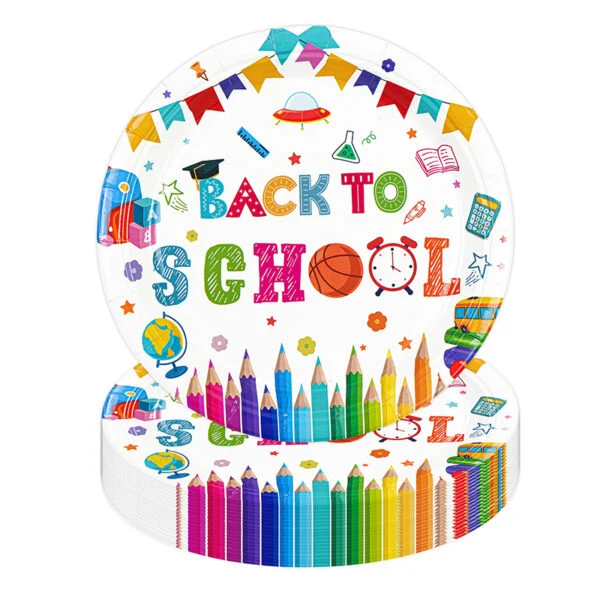
- Printed party plates need extra checks
- What to ask a supplier before buying compostable plates
- Do compostable plates cost more?
- How to set up a plate range that sells in every market
- Frequently Asked Questions – Compostable Paper Plates
Which laws are pushing plastic plates out?
These rules matter most for party supply buyers:
| Market | Rule | In force since | What it means for plates |
| EU | Single-Use Plastics Directive (EU) 2019/904 | 3 July 2021 | Single-use plastic plates banned. Commission guidelines count plastic-lined or plastic-coated paper plates, and bio-based or biodegradable plastics, as plastic. |
| England | Plastic Plates etc. Regulations 2023 | 1 October 2023 | Plates, bowls, trays, cutlery and balloon sticks banned for supply to the public, including compostable plastic and plastic coatings or linings |
| California | AB 1200 | 1 January 2023 | No intentionally added PFAS, or 100 ppm or more total organic fluorine, in plant-fiber food packaging, which the law defines to include disposable plates |
| Colorado, Connecticut and other states | State PFAS food packaging laws | From 1 January 2024 (varies) | Similar bans on intentionally added PFAS in fiber food packaging |
| EU | Packaging and Packaging Waste Regulation (EU) 2025/40 | 12 August 2026 | PFAS limits for food-contact packaging, with no sell-off period for non-compliant stock |
Sources: Intertek summary of the EU SUP guidelines, UK government guidance summarized by packaginglaw.com, SGS on California AB 1200, Mondaq state-by-state PFAS tracker, Food Packaging Forum on the PPWR.
Scotland and Wales have their own single-use plastic bans covering plates.
Does the England ban affect wholesalers?
Only partly. England’s rules let businesses supply plastic plates to other businesses, and to fill them at the point of sale. The ban applies when plates reach a member of the public.
For a wholesaler, that means you can still sell plastic plates to a caterer. But the party shop or online store that sells them to the public cannot. So any plate range sold through retail in England has to be paper or fiber with no plastic in it.
Why PFAS matter for paper plates
PFAS are the “forever chemicals” once used to make paper plates grease-proof. Fluorinated chemicals are one way to make a fiber plate grease-proof without a plastic lining. Regulators have now restricted that route too.
California’s 100 ppm limit is measured as total organic fluorine, so accidental PFAS from recycled fiber can also put a plate over the limit. Ask for a total organic fluorine test report on every plate line you buy for the US or EU.
Which plate materials count as plastic-free?
The plate’s barrier layer decides whether it is plastic-free, not the paper underneath. Here is how the common options compare:
| Plate type | Handles hot, greasy food | Sellable to the public in the EU and England? | Compostable? |
| PE-lined paper | Well | No, it’s a plastic lining | No |
| PLA-lined paper | Well | No, PLA is a bio-based plastic | Industrially, if certified |
| Water-based dispersion coating | Moderately to well | Depends on the polymer. Many count as plastic. | Some are certified |
| Uncoated paperboard | Poorly with wet or oily food | Yes | Yes |
| Bagasse (sugarcane fiber) | Well | Yes, if no plastic barrier | Industrially if certified; home only with a home certificate |
| Bamboo pulp | Well | Yes, if no plastic barrier | Industrially if certified |
| Palm leaf | Well | Yes | Yes |
Bagasse is a widely used plastic-free option for party retail. It is molded from the fiber left after sugarcane is crushed, handles hot food, and takes a printed or embossed design. For a plate-by-plate comparison of paper weights and coatings, see the difference between paper plate qualities.
What “compostable” actually means
A compostable plate breaks down in a composting process within a set time. It does not mean the plate will break down in a landfill, a hedge or the sea.
The main standards are:
- EN 13432 (EU). At least 90% biodegradation within six months, and disintegration within 12 weeks in industrial composting.
- ASTM D6400 and D6868 (US). The US equivalents. BPI certifies products against them and, since 2020, does not certify products with intentionally added fluorinated chemicals.
- TÜV Austria OK compost HOME. A separate certificate for breakdown at the lower temperatures of a garden compost bin.
Many communities have no industrial composting service that accepts plates. In the US, the FTC’s Green Guides say a compostable claim should be qualified if composting facilities aren’t available to a substantial majority of customers. A pack line such as “Commercially compostable. Facilities may not exist in your area” keeps the claim honest.
Printed party plates need extra checks
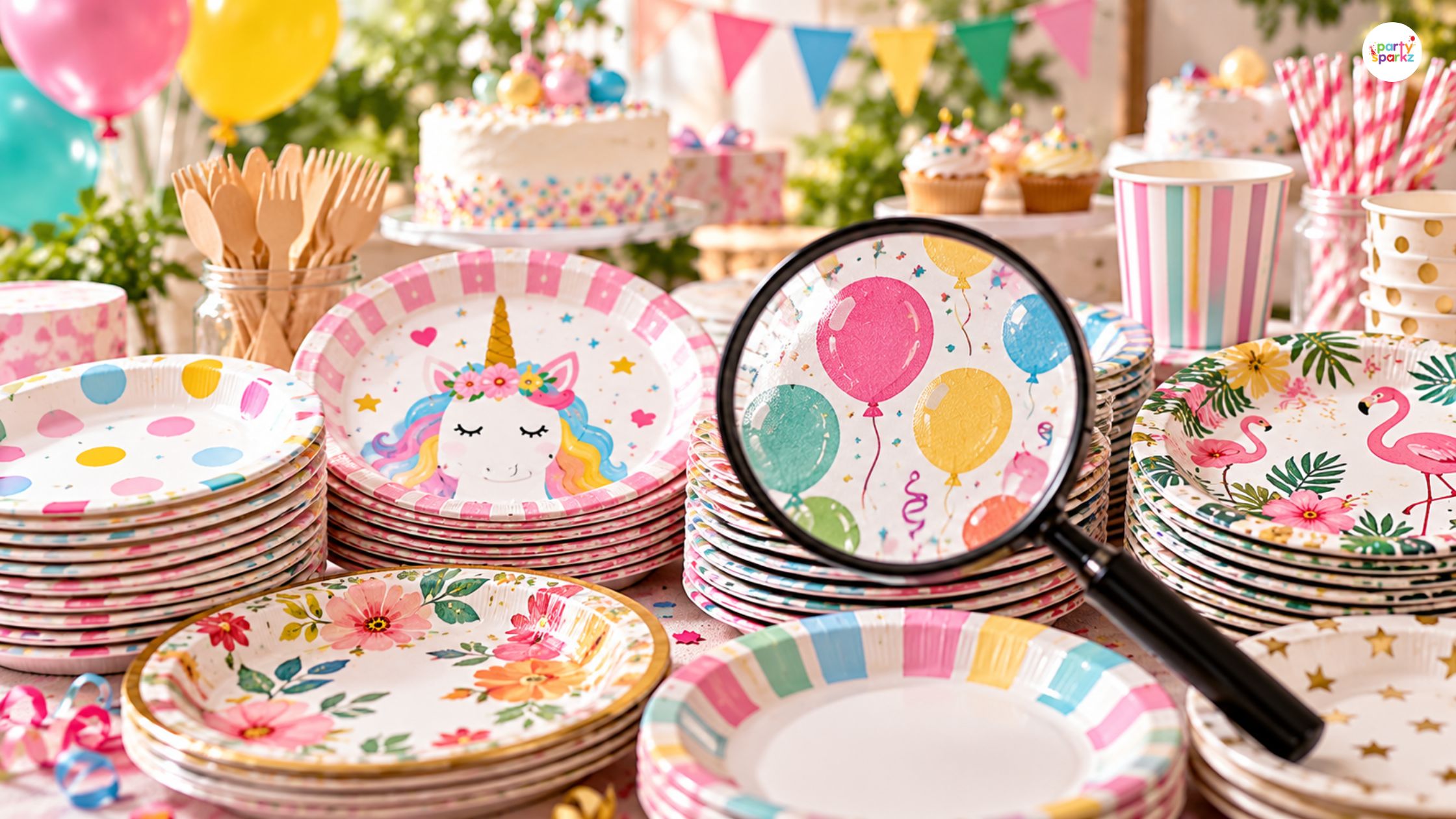
Party plates carry printed designs, and certificates cover the product as tested, including its inks. When you add a new print or a metallic foil finish, ask whether the certificate still covers it.
Foil stamping and glitter are the usual problems. Many are plastic or metal films that can break both the plastic-free claim and the compostable claim.
Also read –
Why Global Buyers Choose Party Supplies for Christmas Decorations
Halloween Decoration Items to Source from China
What to ask a supplier before buying compostable plates
A factory’s product page saying “eco-friendly” proves nothing. Ask for documents:
- The compostability certificate. Get the certificate number, not a logo on a spec sheet, and check it on the certifier’s website (BPI, TÜV Austria or DIN CERTCO). Confirm it names the exact plate size and print you are buying.
- The coating composition. Ask what the grease and water barrier is made of. For EU and UK orders, get a written statement that the plate contains no plastic lining or plastic-based coating under the Single-Use Plastics Directive or England’s 2023 regulations.
- A PFAS test report. Ask for a total organic fluorine result from an accredited lab. California’s limit is 100 ppm, and the EU’s PPWR sets a total fluorine limit too.
- A food-contact declaration. For the EU, a declaration of compliance with Regulation (EC) 1935/2004. For the US, a statement on FDA food-contact status.
- Performance results. Ask for hot oil and hot water hold tests, or test samples yourself with your customers’ typical food.
PartySparkz states that its eco and premium plate ranges carry current PFAS-free documentation, and its eco range includes BPI-certified bagasse plates. Ask for the certificate numbers and test reports that cover the exact plates and prints you order.
Do compostable plates cost more?
Usually, yes. Bagasse and certified paper plates generally cost more per plate than standard PE-coated paper plates. Ask for quotes on both, at the same size and print, so you can see the difference for your range.
In the EU and England, the comparison that matters is between compliant options, because plastic-lined plates cannot be sold to the public at any price. In US states with PFAS laws, compare PFAS-free plates with each other, not with the cheapest imports.
How to set up a plate range that sells in every market
The simplest approach is one plastic-free, PFAS-free plate spec for every market. Running a separate plastic-lined version for markets without bans means two sets of stock, two sets of artwork, and the risk of shipping the wrong one.
Build the rest of the table around the same rules:
- Cutlery. Plastic cutlery is banned for the public in the EU and England. Wooden or bamboo cutlery is the usual swap.
- Cups. Paper cups with a plastic lining are still allowed in the EU, but they must carry the EU’s single-use plastic marking.
- Napkins and paper tablecovers. No plastic, so no change needed.
- Balloon sticks. Plastic sticks sold to the public are banned in the EU and England. Paper sticks are the replacement.
For the full range of printed plates, cups and napkins, see PartySparkz party tableware. For a broader look at the paper versus plastic decision, read paper plates vs plastic plates.
Switching your plate range
Start with the markets you sell to, then pick a material and coating that is legal in all of them. Get the certificate and PFAS report before you approve artwork. At PartySparkz, in-stock printed plate sets start from 20 to 100 sets depending on the design, and custom orders start from 500 pieces. Standard production takes 15 to 25 days, plus 10 to 15 days for custom prints.
For quotes on plastic-free printed plates, browse PartySparkz wholesale party supplies or send your sizes and designs through the bulk order form.
Frequently Asked Questions – Compostable Paper Plates
Yes, if they contain no plastic. A bagasse or uncoated paper plate is fine. A paper plate lined with PLA is not, even though PLA is compostable, because the EU counts bio-based plastics as plastic.
In industrial composting, plates certified to EN 13432 disintegrate within 12 weeks and are at least 90% biodegraded within six months. In a home compost bin, only plates with a home-compost certificate are tested to break down, and it takes longer. In a landfill, the timing is unpredictable.
Most bagasse plates are sold as microwave-safe, but check the supplier’s specification for the exact product. Printed designs and any coatings can change the rating.
No. “Biodegradable” has no set time frame or test. Look for a named compostability standard and a certificate number instead.
In many markets, yes. But plastic plates cannot be sold to the public in the EU or England, and plant-fiber plates must be PFAS-free in several US states. A single plastic-free, PFAS-free spec avoids problems as more markets add rules.