
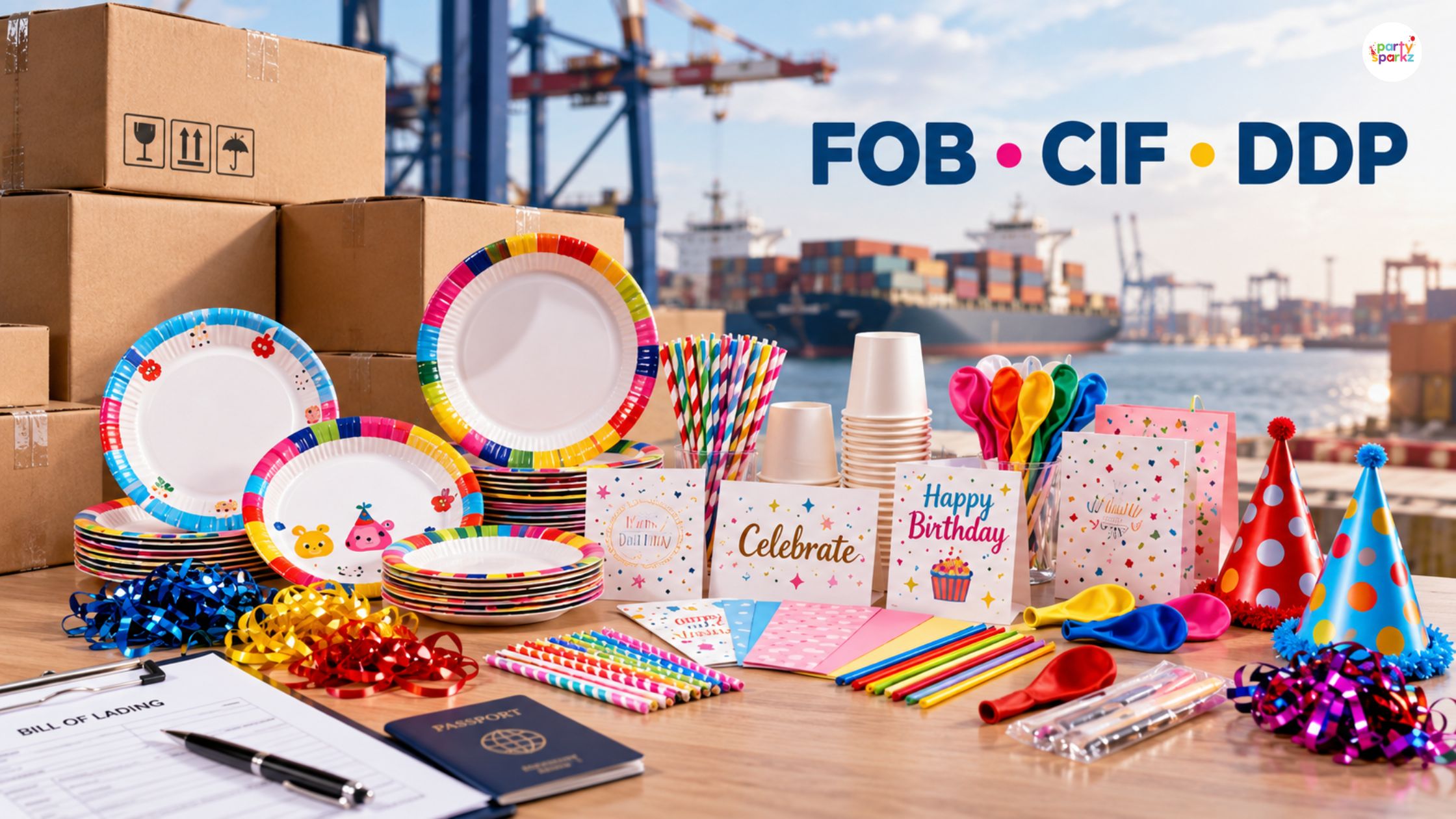
FOB vs CIF vs DDP: For a first-time party supply importer, DDP (Delivered Duty Paid) is usually the simplest option: the supplier handles freight, customs clearance, and duties, and you receive a landed price with no logistics coordination required. FOB and CIF give you more control and often a lower headline price, but they require you to manage freight booking, insurance, or customs clearance yourself.
Here’s what each term actually means, what changes at each stage of the shipment, and which one fits your first order.
Table of contents
- What Incoterms actually are
- FOB (Free On Board)
- CIF (Cost, Insurance, and Freight)
- DDP (Delivered Duty Paid)
- Side-by-side comparison
- Why first-time importers usually do better with DDP
- What DDP doesn’t remove
- When to move away from DDP
- Questions to ask a supplier before your first order
- Frequently asked questions
What Incoterms actually are
Incoterms (International Commercial Terms) are a standardized set of trade terms published by the International Chamber of Commerce. They define exactly where the seller’s responsibility ends, and the buyer’s begins, for cost, risk, and paperwork, so both sides agree on the split without renegotiating it shipment by shipment.
For party supplies specifically, this matters more than it might seem. Balloons, banners, and decorations are light, bulky, and often shipped in mixed cartons, meaning freight and handling costs make up a larger share of total cost than they would for denser cargo. Getting the Incoterm wrong on your first order can mean unbudgeted costs showing up after the goods are already on the water.
FOB (Free On Board)
The supplier’s responsibility ends once your goods are loaded onto the vessel at the origin port. From that point forward, you (the buyer) arrange and pay for ocean freight, marine insurance, customs clearance at destination, and final delivery to your warehouse.
What you’re responsible for under FOB:
- Booking the freight forwarder and vessel space
- Arranging cargo insurance
- Customs clearance and duty payment at destination
- Inland delivery from the port to your warehouse
Best for: importers who already have a freight forwarder relationship, or who import often enough that managing freight directly saves real money over time.
CIF (Cost, Insurance, and Freight)
The supplier arranges and pays for ocean freight and marine insurance to your named destination port. You’re still responsible for customs clearance, duties, and final delivery once the goods arrive.
What you’re responsible for under CIF:
- Customs clearance and duty payment at destination
- Inland delivery from the port to your warehouse
Best for: buyers who want the freight and insurance coordination handled, but are comfortable managing customs clearance themselves, or already work with a local customs broker.
Also read – factory direct party supplies manufacturer
DDP (Delivered Duty Paid)
The supplier handles everything: freight, insurance, customs clearance, and duty payment, all the way to your door. You receive one all-in price with no separate logistics steps to manage.
What you’re responsible for under DDP:
- Receiving the shipment and confirming it against your order
Best for: first-time importers, smaller businesses without an existing freight or customs broker relationship, or anyone importing into a market with import requirements they aren’t yet familiar with.
Side-by-side comparison
| FOB | CIF | DDP | |
| Freight arranged by | Buyer | Seller | Seller |
| Insurance arranged by | Buyer | Seller | Seller |
| Customs clearance handled by | Buyer | Buyer | Seller |
| Duties paid by | Buyer | Buyer | Seller (built into price) |
| Final delivery arranged by | Buyer | Buyer | Seller |
| Logistics coordination required from buyer | High | Medium | Low |
| Typical fit | Experienced importers | Mid-experience importers | First-time importers |
Why first-time importers usually do better with DDP
Party supplies carry a specific complication: many items (foil balloons, certain novelty items, seasonal decorations) can trigger classification questions at customs, and getting an HS code wrong is one of the most common reasons a first shipment gets delayed or costs more than expected.
Under DDP, the supplier is the one managing that classification and clearance process, since they’re the one contractually responsible for getting the goods through customs. For a first order, this removes the single biggest source of surprise cost: not the freight rate, which is fairly predictable, but customs friction, which usually isn’t, if you don’t already know the process.
What DDP doesn’t remove
DDP simplifies logistics; it doesn’t eliminate your responsibility to check the shipment on arrival. Confirm quantities, check for damage, and reconcile the delivery against your purchase order and packing list, the same as you would under any Incoterm. DDP moves who arranges customs and delivery, not who verifies the goods actually match what was ordered.
It’s also worth asking directly what “delivered” means in a DDP quote: to your warehouse door, or to a regional distribution hub you then need to arrange onward transport from. Confirm the exact delivery point before comparing a DDP quote against an FOB or CIF alternative.
When to move away from DDP
DDP is the easiest starting point, not necessarily the cheapest option long term. Once you’ve placed a few orders and understand your import process, freight costs, and customs requirements, FOB or CIF can offer real savings, particularly if you have consistent order volume and can negotiate freight rates directly.
Many importers start on DDP for their first 2 or 3 orders, then transition to FOB or CIF once they’ve either built a freight forwarder relationship or found the DDP premium isn’t worth it at their order volume.
Questions to ask a supplier before your first order
- Is your quoted price FOB, CIF, or DDP, stated explicitly, not assumed?
- If DDP, does “delivered” mean my warehouse door or a regional hub?
- Do you provide a Proforma Invoice with HS codes and Incoterms clearly listed?
- If I want to use my own freight forwarder later, can you support FOB or Ex-Works instead?
- What happens if a shipment is delayed or damaged? How does responsibility differ under the Incoterm we’re using?
Frequently asked questions
DDP (Delivered Duty Paid) is generally the easiest, since the supplier handles freight, customs clearance, and duty payment, leaving you with one all-in delivered price and no separate logistics steps to coordinate.
Often yes, since the supplier is pricing in the cost and risk of handling customs and delivery on your behalf. For buyers new to importing, that premium is frequently worth it to avoid customs delays or classification mistakes on a first shipment.
Usually yes. Many importers start with DDP and move to FOB or CIF once they’ve built their own freight and customs relationships, or once order volume justifies managing logistics directly.
Yes, responsibility and insurance coverage depend on which Incoterm applies and at what point in the shipment the damage occurred. Confirm this explicitly with your supplier rather than assuming coverage is automatic under any term.
Related reading
If you’re still mapping out the full import process beyond Incoterms, our guide on how to import party products from China covers sourcing, documentation, and freight options end to end. For a breakdown of what actually drives your per-unit cost once freight and duties are added in, see wholesale party supplies price. You can also check our FAQ page for how Incoterms and documentation work specifically for PartySparkz orders.
Incoterms definitions in this piece follow the International Chamber of Commerce’s official framework; the full current rules are available at iccwbo.org.
This article is for general informational purposes and isn’t a substitute for advice from a licensed customs broker or freight forwarder. Confirm specific terms, coverage, and responsibilities directly with your supplier before placing an order.