
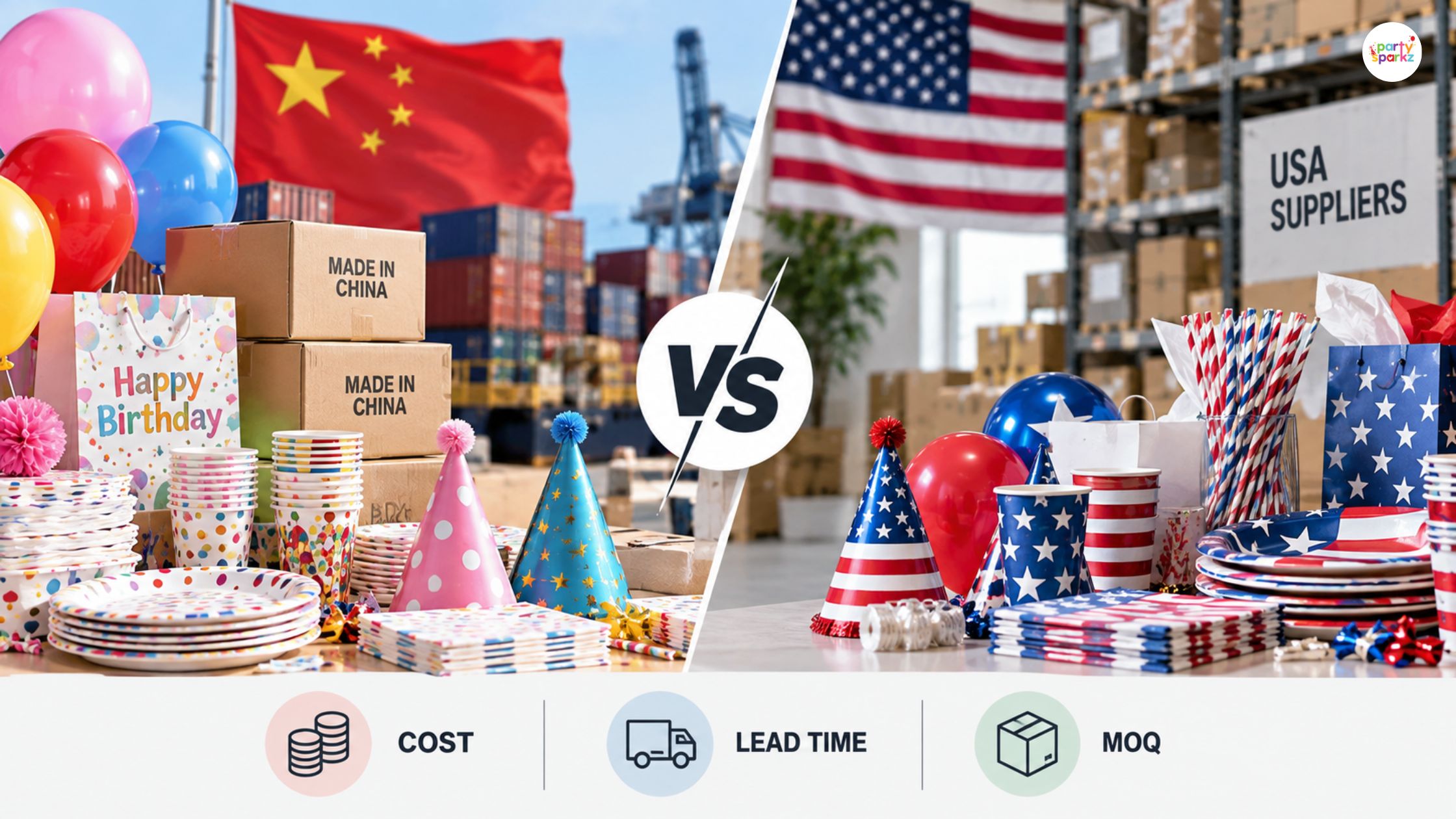
China-based suppliers generally offer lower per-unit product costs but higher minimum order quantities and longer lead times (30-60 days production plus shipping), while USA-based suppliers offer faster turnaround (often 1-2 weeks) and lower MOQs, but at a higher per-unit price. As of 2026, rising US tariffs on Chinese goods have narrowed, though not eliminated, China’s cost advantage, making the right choice increasingly dependent on order volume, timeline, and product category rather than price alone.
This guide breaks down the real cost, speed, and order-size tradeoffs between sourcing wholesale party supplies from China versus the USA, including how 2026 tariff changes are reshaping the math.
Table of contents
- Quick Comparison: China vs USA Wholesale Suppliers
- How Do 2026 Tariffs Affect the China Cost Advantage?
- How Do Lead Times Compare?
- How Do Minimum Order Quantities Compare?
- Which Option Makes Sense for Which Retailer?
- Should Retailers Source From Both Countries at Once?
- Where Can Retailers Compare Current Wholesale Pricing?
- Quick Answer Recap
Quick Comparison: China vs USA Wholesale Suppliers
| Factor | China Suppliers | USA Suppliers |
| Per-unit product cost | Lower base price, often 30-60% cheaper before duties | Higher base price |
| Total landed cost (2026) | Base price + tariffs (roughly 20-40%+ depending on HTS code) + freight | Base price only, no import duty |
| Typical MOQ | 500-5,000+ units per SKU | 50-500 units per SKU |
| Lead time | 30-60 days production + 20-35 days ocean freight (or 7-10 days air, at higher cost) | 3-14 days |
| Quality consistency | Varies significantly by factory; requires vetting | More standardized, easier to inspect in person |
| Customization | Strong for high-volume custom molds/designs | Better for small-batch or rush customization |
| Best suited for | Large, recurring orders with long lead-time planning | Fast reorders, seasonal top-ups, new product testing |
How Do 2026 Tariffs Affect the China Cost Advantage?
Tariffs are the single biggest variable that’s changed the China-vs-USA sourcing math over the past year, and it’s worth understanding the current landscape before assuming China is automatically cheaper.
As of 2026, Chinese-origin goods face a stacked tariff structure: a Section 122 global surcharge, Section 301 duties left over from earlier trade actions, and in some cases, sector-specific tariffs that combine to push effective rates on general manufactured goods (a category most party supplies fall under) into the roughly 20-40% range, depending on the exact HTS code and product classification. This is a meaningful swing from the sub-100% spikes seen in parts of 2025, but it’s still a real cost layer that didn’t exist a few years ago.
Two additional changes matter specifically for smaller retailers:
- The $800 de minimis exemption for China was eliminated in 2025. Previously, individual packages under $800 could clear US customs duty-free — a workaround many small retailers and dropshippers relied on. Every package from China now requires formal customs entry and full tariff assessment, regardless of value.
- Tariff rates remain volatile and product-specific. The exact rate a retailer pays depends heavily on how a product is classified under its Harmonized Tariff Schedule (HTS) code, and rates have shifted multiple times within the past 18 months. Retailers importing regularly from China should work with a customs broker to confirm current rates before finalizing landed-cost calculations, rather than relying on a number that may already be outdated by the time an order ships.
The practical takeaway: China can still offer a real cost advantage at scale, particularly for retailers placing large, recurring orders where the per-unit savings outweigh the duty layer, but the days of assuming China is automatically 50%+ cheaper after landed costs are largely over. Retailers should run the full landed-cost math (product cost + duty + freight + customs brokerage) before comparing it against a domestic quote.
Also read – What Party Supplies Sell Best for Retailers Buying Wholesale
How Do Lead Times Compare?
Lead time is often the deciding factor for retailers working against a seasonal deadline.
China suppliers typically require 30-60 days for production alone, particularly for custom molds, printed designs, or first-run orders. Add ocean freight — generally 20-35 days depending on port and season — and a retailer is realistically looking at 2-3 months from order to delivery. Air freight can cut this to 7-10 days but usually adds 3-5x to the shipping cost per unit, which only makes sense for smaller, higher-margin, or genuinely time-critical orders.
USA suppliers, by contrast, typically ship finished goods in 3-14 days since there’s no cross-border customs clearance or extended ocean transit involved. This makes domestic suppliers the practical choice for last-minute seasonal reorders — a retailer realizing in early October that they’re short on Halloween inventory has no realistic option except a USA-based supplier, since a China order placed at that point won’t arrive before the season passes.
This lead-time gap is a major reason retailers building a wholesale party supplies USA sourcing relationship often keep it specifically for fast-turnaround, in-season reorders, while reserving China wholesale party supplies manufacturers for planned, high-volume orders placed months ahead of a season.
How Do Minimum Order Quantities Compare?
MOQ is where the gap between China and USA sourcing is often most dramatic, and it directly affects which retailers can realistically use each option.
China manufacturers commonly set MOQs between 500 and 5,000+ units per SKU, especially for custom-printed or molded products like themed balloons, printed tableware, or licensed-style decor. Some factories will negotiate lower MOQs for standard, non-customized items, but custom branding or unique designs almost always push the minimum higher, since it requires a dedicated production run.
USA suppliers and distributors, including many listed through B2B marketplaces, typically offer MOQs in the 50-500 unit range, and some boutique or small-batch domestic manufacturers will fulfill orders even smaller than that. This makes USA sourcing far more accessible for new retailers or those testing a product category before committing to bulk inventory.
This MOQ gap is a major reason sourcing guidance aimed at wholesale party supplies for business owners or those just starting to buy wholesale party supplies for resale tends to recommend starting with domestic or marketplace suppliers before graduating to China-direct manufacturing once sales volume justifies a 1,000+ unit commitment.
Which Option Makes Sense for Which Retailer?
The right sourcing country depends less on price alone and more on order volume, timeline flexibility, and how much customization is needed:
- New or small retailers testing a category — USA suppliers or B2B marketplaces are usually the better starting point, given lower MOQs and no tariff exposure.
- Retailers ordering common, non-customized categories at scale — balloons, basic tableware, and standard decor — China manufacturing can still offer real per-unit savings even after 2026 tariffs, provided the order is large enough and placed with enough lead time.
- Retailers needing custom branding, licensed designs, or unique molds — China is typically the only realistic option at reasonable per-unit cost, but retailers should plan 3+ months and build tariff costs into pricing from the start.
- Retailers managing seasonal reorders or last-minute stock gaps — USA suppliers are the only practical option once a season is already underway, regardless of the cost premium.
- Retailers serving hotels or event planners with recurring but variable order sizes often blend both, a China-sourced core inventory for evergreen items, topped up with USA suppliers for smaller, faster-turnaround custom requests.
Should Retailers Source From Both Countries at Once?
Increasingly, yes. A growing number of established retailers run a blended sourcing strategy rather than committing entirely to one country: a large, planned China order covers baseline inventory for predictable, high-volume categories like balloons and standard tableware, while a domestic supplier relationship, such as one built around wholesale party supplies USA vendors, handles reorders, seasonal top-ups, and any SKU where a stockout would otherwise mean lost sales.
This dual approach also hedges against tariff volatility. Since US tariff policy on Chinese goods has changed multiple times within the past two years, retailers relying entirely on China-sourced inventory carry more exposure to sudden cost swings than those with an established domestic backup supplier already in place.
Where Can Retailers Compare Current Wholesale Pricing?
For retailers wanting a real-world benchmark before deciding which sourcing route fits their order, browsing an established catalog, such as PartySparkz’s wholesale party supplies or event and party supplies wholesale range, can give a useful sense of current landed pricing across both domestically-stocked and manufacturer-sourced categories, without needing to run separate quotes from scratch.
Quick Answer Recap
China suppliers still offer lower base per-unit pricing and stronger economics at high volume, but 2026 tariffs (roughly 20-40% on most general manufactured goods, plus the end of the de minimis exemption) have meaningfully narrowed that advantage, and long production-plus-freight lead times (2-3 months typical) make China unsuitable for urgent reorders. USA suppliers cost more per unit but offer far lower MOQs, faster turnaround (days rather than months), and zero tariff exposure — making them the better fit for new retailers, seasonal top-ups, and smaller test orders. Most established retailers end up using both: China for planned, high-volume baseline inventory, and USA suppliers for speed and flexibility.