
Yes, Quality of China-Made Party Supplies for Resale, but only when you know what you are buying, who you are buying it from, and what questions to ask before a single dollar leaves your account. China-made party supplies range from genuinely retail-ready products that major global chains stock year-round to items that arrive damaged, colour-mismatched, or non-compliant with market regulations. The difference between those two outcomes is rarely the country of manufacture. It is the tier of the factory, the due diligence process, and the specific product category.
Table of contents
- Why the “Made in China” Question Is the Wrong Starting Point
- What Are People Really Asking Before They Buy?
- The Four Quality Tiers of China Party Supply Manufacturing
- Which Product Categories Hold Up Best and Which Are Most Risky?
- The Compliance Question: What Certifications Actually Matter for Party Supplies?
- How to Verify Quality Before Committing to a Large Order
- What Real Buyer Reviews Actually Tell You
- What Changes When You Source Through an Established Wholesale Partner
- The Honest Summary: A Quality Assessment by Category
- Frequently Asked Questions
Why the “Made in China” Question Is the Wrong Starting Point
Every major party supply brand sold through UK supermarkets, US big-box retail, and Australian department stores sources from Chinese manufacturers. The paper plates at a Tesco baby shower, the foil balloons at a Target birthday aisle, and the garlands draped across a Myer Christmas section were made in factories in Guangdong, Zhejiang, and Shandong provinces. This is not a quality compromise — it is simply where the manufacturing expertise, the supply chain depth, and the production economics for party supplies are concentrated at global scale.
The question worth asking is not whether China-made party supplies can be of retail quality. They self-evidently can, because they already are the products being sold at retail globally. The right question is: how do you identify and access that quality tier specifically, rather than landing in the tier below it?
According to sourcing analysis from Supplier Ally, China’s manufacturing quality breaks into four tiers. Premium export quality, which accounts for approximately 15% of Chinese factory output, meets full international standards, uses specified materials without substitution, and undergoes proper testing. Standard export quality — roughly 40% of export manufacturing — meets basic international requirements with occasional material substitution. Domestic premium quality is produced for China’s middle-class market and may not meet all international standards. Domestic standard and budget tiers represent the lowest quality formal manufacturing and, in some cases, operate below regulatory requirements.
For party supply buyers sourcing for resale, the target is the standard export tier as a minimum and the premium export tier for any product category where quality failures would directly impact the customer experience. The challenge is that all four tiers often appear identical in a B2B platform listing. Price is a signal, but not always a reliable one. Factory type, production verification, and sample quality are the real differentiators.
What Are People Really Asking Before They Buy?
The questions appearing most consistently across sourcing forums, wholesale buyer communities, and real customer reviews tell you exactly where the genuine uncertainty sits.
“How do I know if the product I receive will actually look like the sample?” This is the most frequently asked question in wholesale party supply communities, and the anxiety behind it is legitimate. The sample represents one unit from a small batch. The production run represents thousands of units from a high-speed line with potentially different material batches, different operators, and different quality control pressure.
“What categories fail most often on quality?” There is a reliable answer to this, and it is covered in full below, because the risk profile is genuinely different across product types.
“What certifications should I ask for, and how do I know if they are real?” Certification fraud is a documented problem in China-origin goods. Real buyers have received fake CE certificates, fabricated lab reports, and forged test documentation. Knowing what a legitimate certification looks like and how to verify it is a basic competency for any commercial importer.
“How do I handle it when goods arrive damaged or wrong?” The answer depends entirely on whether you have a pre-shipment inspection in place and what your payment terms protect.
“Is there actually a meaningful quality difference between cheap and mid-priced Chinese party supplies, or is it all from the same factory?” Sometimes yes, sometimes no. The honest answer requires understanding how China’s manufacturing tier system works, which is not how most buyers imagine it.
The Four Quality Tiers of China Party Supply Manufacturing
Understanding that Chinese manufacturing is not a monolith, that there are structured, identifiable quality tiers with genuinely different outcomes for resellers, is the most commercially useful reframe for any buyer approaching this market.
The premium export tier produces the goods that carry well-known brand licences, fill the shelves of ASDA, Walmart, and Target, and pass the kind of rigorous product testing that large retailers require before a product touches their supply chain. Factories at this tier have dedicated quality departments, production-line testing protocols, standardized materials specifications, and export documentation systems that are built for international compliance requirements. They typically hold third-party certifications from bodies like Bureau Veritas or Intertek rather than self-issued declarations. Their MOQs are usually higher, and their prices are not the cheapest on any sourcing platform. They are also not particularly easy to find through a cold Alibaba search.
The standard export tier is where most international B2B buyers end up when sourcing through online platforms. These factories meet basic international requirements most of the time, with occasional material substitution that does not always match the sample specification exactly. Products from this tier are often perfectly acceptable for resale with proper pre-shipment inspection in place, and many experienced importers build very successful wholesale businesses sourcing here. The risk is inconsistency across production batches — what your first order looks like and what your fifth order looks like may differ in ways that are difficult to predict without ongoing quality monitoring.
The domestic tiers — domestic premium and domestic budget represent products manufactured primarily for the Chinese internal market or for the very lowest price points on international platforms. A 2025 supplier audit cited in the furniture sourcing context found that 23% of “Verified Supplier” listings on major B2B platforms were trading companies or domestic-tier manufacturers presenting as export-quality factories. In party supplies, the proportion is likely similar. A buyer who chooses the cheapest available option without factory verification has a material probability of landing in this tier, and the quality consequences are real: thin material weights, unstable colour dyes that fade or bleed, weak structural integrity in banners and hanging decorations, and balloon latex that does not meet the minimum inflation and burst specifications for party use.
Also read – Monochrome party setups
Which Product Categories Hold Up Best and Which Are Most Risky?
Party supplies is not a single product category. It spans paper goods, rubber products, plastic items, metallic foils, fabric and textile accessories, printed materials, and novelty items — and the quality risk profile is genuinely different across each.
Categories That Consistently Perform Well at Mid-Tier Sourcing
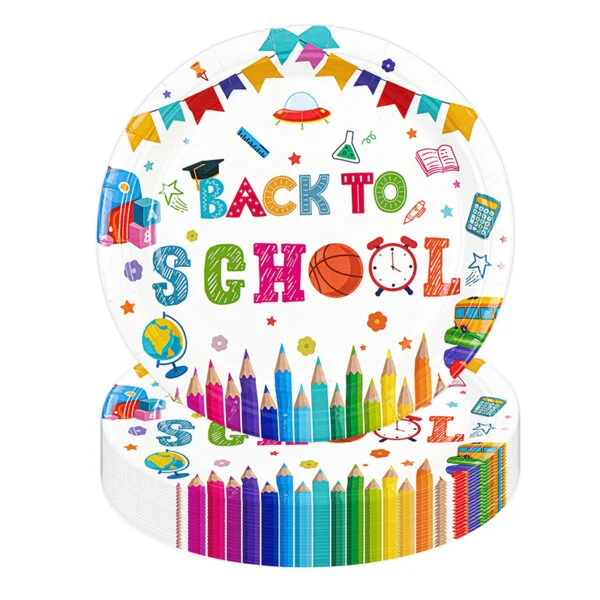
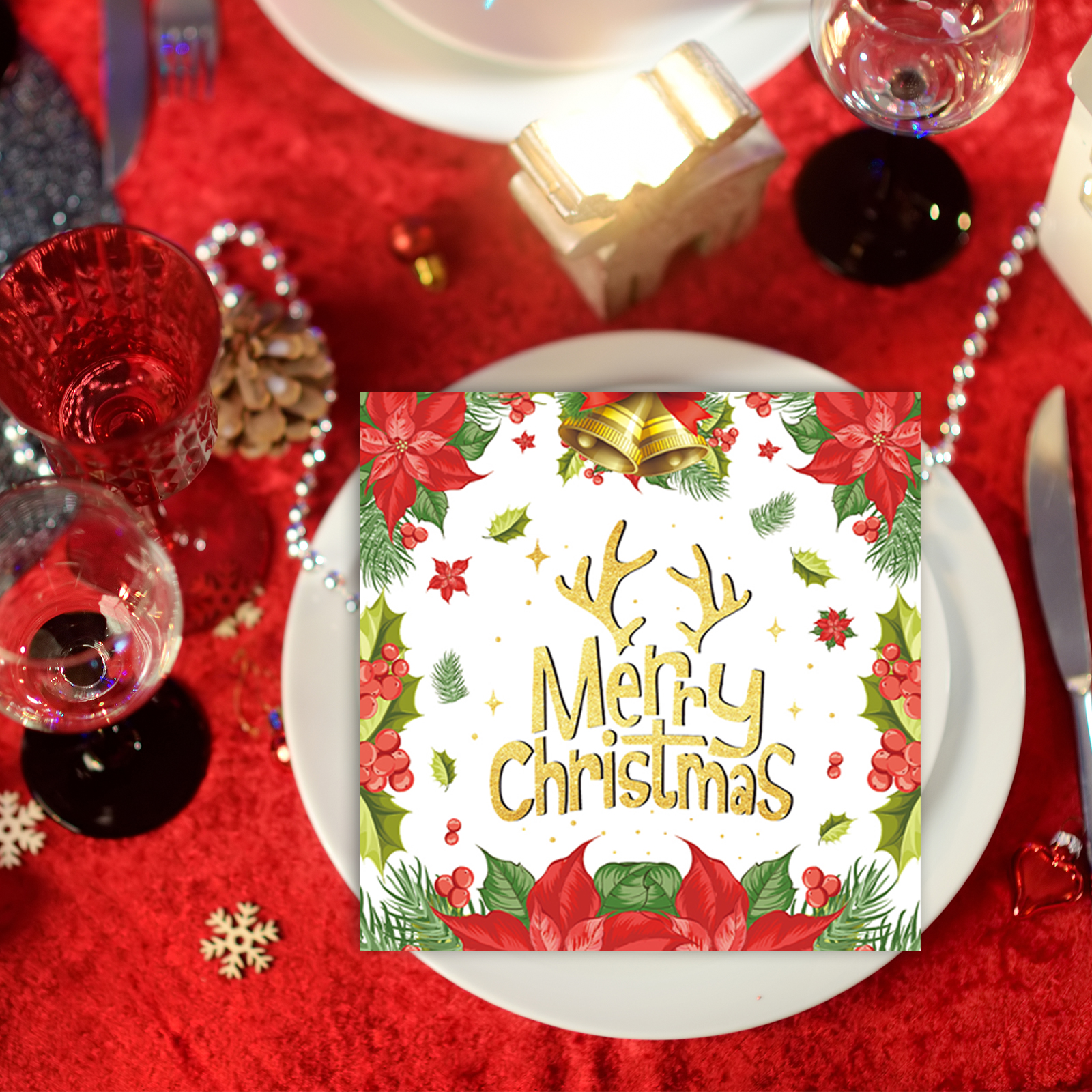
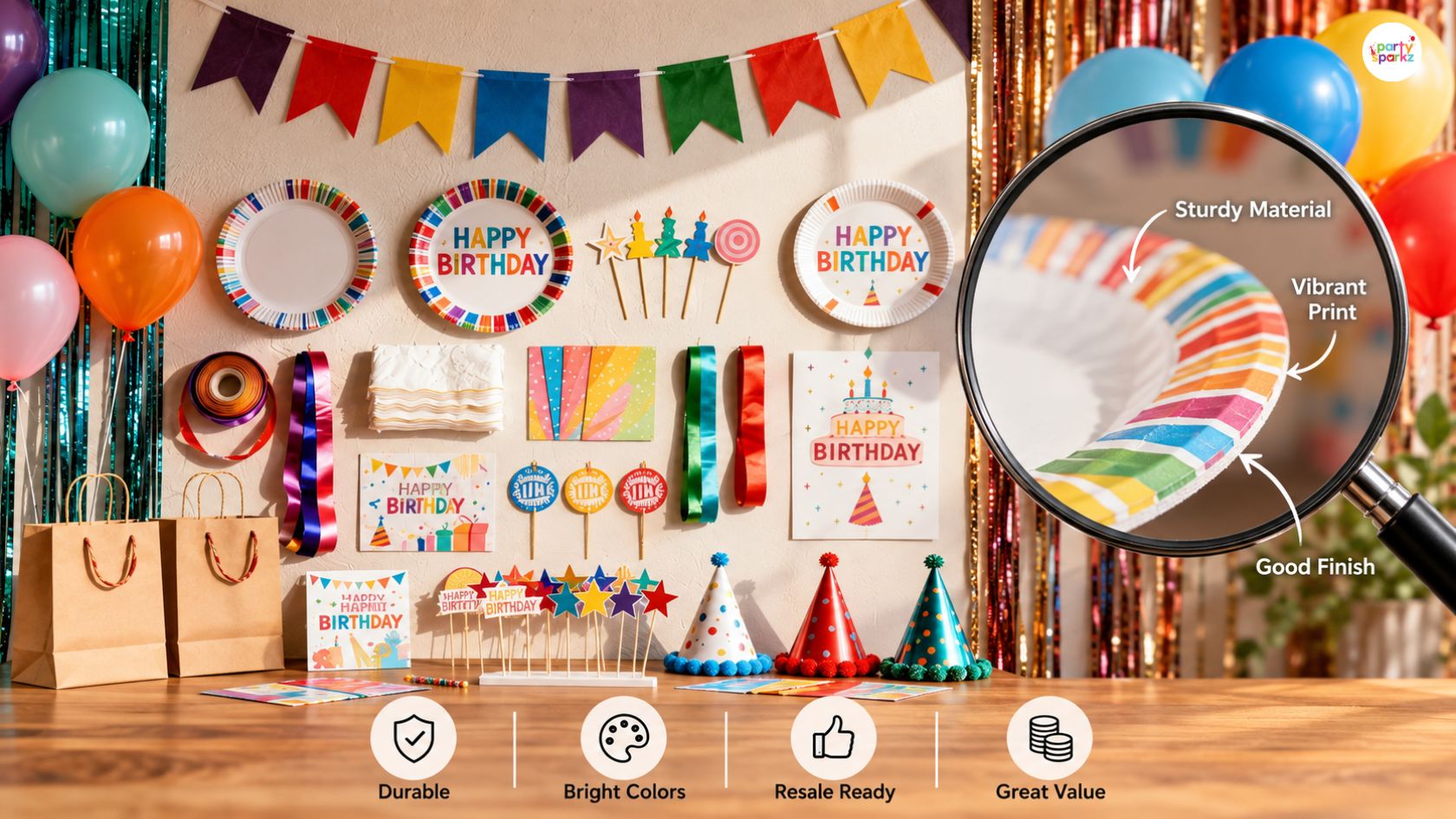
Paper tableware — plates, cups, and napkins — is one of the most reliable categories to source from China at the mid-tier factory level. Paper manufacturing in China is technically mature and heavily automated. The variables that affect quality (GSM weight, print registration, coating integrity, structural rigidity) are measurable and easy to verify in a sample. Buyers who have checked the GSM on their sample plates against what arrives in production have a clear basis for a quality dispute if the weights diverge. This is a category where even standard export tier factories consistently produce resaleable product.
Foil balloons represent another strong category. Metallized film balloon manufacturing in China is technically sophisticated and export-focused. The quality differentiators — print clarity, seam integrity, inflation valve quality, and helium retention duration are all testable in advance, and Chinese foil balloon manufacturers have been supplying global markets, including the US, UK, and Australia, for decades. The risk in this category is less about manufacturing quality than about colour accuracy across batches and print registration consistency.
Banners, bunting, and garland products manufactured from polypropylene, paper, or fabric are generally reliable when specified correctly. The key specification to confirm is the material weight per metre, which determines how the product drapes, holds shape, and photographs. Garland products manufactured from tissue paper are more fragile in transit and need adequate packaging specifications in the order.
Categories Where Quality Variance Is Most Significant
Latex balloons are arguably the category where quality variance creates the most direct impact on the end customer experience. Balloon quality is determined by the natural latex compound formulation, wall thickness consistency, and the manufacturing process control that maintains uniform thickness across every balloon in a batch. Thin patches in balloon walls cause premature bursting. Inconsistent wall thickness creates uneven inflation shapes that look amateur in a balloon arch. Colour stability in latex depends on the pigment quality — budget-tier latex balloons often fade within 24 hours of inflation due to low-grade pigment compounds that degrade rapidly.
The test for latex balloon quality that any buyer can perform before placing a wholesale order is straightforward: inflate ten randomly selected balloons from your sample, fill them to the manufacturer’s stated inflation size, and observe over 48 hours. Count the percentage that burst, deflate, or develop visible wall irregularities. A premium export tier latex balloon should show near-zero failures in this test. A budget-tier balloon will frequently show failure rates of 5–15% in the same conditions — which is commercially unacceptable for a product that customers will be inflating the morning of an event.
Printed fabric and textile accessories — sashes, tabletop banners, printed tablecloths with photographic printing — carry quality risk around print fastness and fabric quality. Low-grade sublimation inks on synthetic fabric lose vibrancy after the first washing or prolonged exposure to light. For items intended for single-use events this may be acceptable, but for any item that might be described as reusable or durable, print fastness should be explicitly tested.
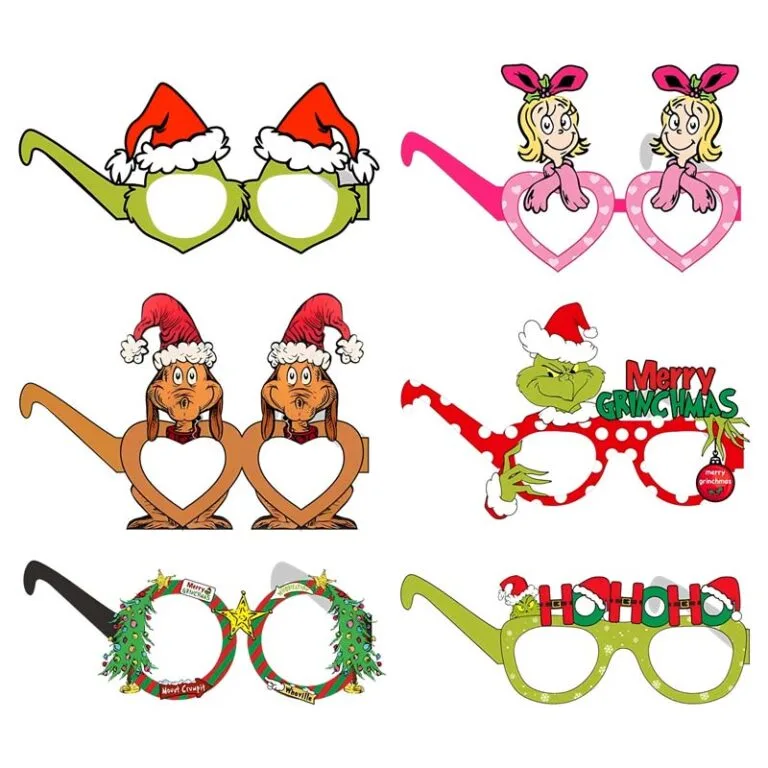
Novelty items and plastic accessories — glasses, hats, props, and wearable accessories — span the widest quality range of any party supply category. Injection-moulded plastic quality in China ranges from very good to genuinely poor depending on the plastic grade and the mould tooling age. The specific risk for plastic novelty items in resale is compliance: certain plastic accessories contain phthalate plasticisers or other restricted substances that fail REACH in the EU, CPSC requirements in the US, or ACCC standards in Australia. This is not a hypothetical risk — it is a documented compliance category that has resulted in market recalls of party supply items across all three markets.
The Compliance Question: What Certifications Actually Matter for Party Supplies?
This is the area where buyers most often underinvest in their due diligence, and it is also the area where the consequences of getting it wrong are most severe — not just a customer complaint about quality but a regulatory enforcement action, a product recall, or a customs seizure.
For paper tableware that will be in contact with food — plates, cups, and napkins — the relevant compliance framework depends on the market. In the EU, EU Regulation 1935/2004 governs all food contact materials and requires a Declaration of Compliance (DoC) from the manufacturer confirming that materials meet specified requirements, including migration limits. The DoC is not a certificate issued by a third party — it is a manufacturer-issued document backed by laboratory test reports from an accredited testing body. A buyer who asks for a DoC and receives only the document without the supporting lab report has received half of the required compliance evidence. For the US market, FDA compliance under 21 CFR for food contact materials is demonstrated through test reports and a Letter of Guarantee from the manufacturer, not a physical certificate.
For latex balloons manufactured for sale to the general public, the EN 13432 standard and the EU Toy Safety Directive 2009/48/EC are relevant for balloons sold as children’s toys or party items. The toy safety directive specifically requires compliance with EN 71-7 for products containing elastomers, including limits on N-nitrosamines and N-nitrosatable substances. Latex balloons from budget-tier manufacturers who have not invested in compliant rubber compound formulations can fail these limits. A buyer who cannot obtain the test report specifically demonstrating EN 71-7 compliance should not be sourcing latex balloons for sale in the UK or EU.
For plastic novelty items and accessories, REACH compliance in Europe requires that restricted substances — including phthalates, heavy metals, and certain chemical compounds — are present below the limits specified in Annex XVII. This is tested by accredited laboratories, and the test report should be requested alongside any product safety documentation. Items marketed to children face additional requirements under the General Product Safety Regulation that took effect in the EU in 2024 and that the UK has followed in substance.
The practical approach for buyers is to create a compliance checklist by product category before placing any order and to require the documentation that accompanies each item. Established manufacturers at the premium and standard export tiers will have this documentation in place as part of their normal export operations. A supplier who cannot or will not provide compliance documentation for a product category that legally requires it is telling you something important about where they sit in the quality tier structure.
How to Verify Quality Before Committing to a Large Order
The sequence that experienced wholesale buyers follow for any new supplier relationship is consistent across sourcing communities, and it is not complicated. What distinguishes experienced buyers is that they actually follow it rather than skipping steps under time pressure.
The first step is requesting a sample, specifically, a production sample, not a custom-made showroom sample. The distinction matters because a factory can produce a flawless single unit to win an order that it cannot replicate in a high-speed production run. Specify that you want a sample pulled randomly from a recent production batch, or from a production run of your order specification. Pay for the sample without asking for it free suppliers who charge for samples, and these suppliers are usually real manufacturers with production costs to cover. Suppliers who offer free samples of complex products are more often trading companies showing you someone else’s goods.
The second step is testing the sample against your specification. For every product category with a measurable quality dimension, balloon wall thickness, paper GSM weight, print colour accuracy against the Pantone reference, tensile strength for banner eyelets, test it. You do not need a laboratory for most of these tests. A kitchen scale gives you paper GSM. A vernier calliper gives you the material thickness. An inflation test over 48 hours gives you balloon integrity. The results of these tests become the quality specification that you incorporate into the purchase contract.
The third step is a pre-shipment inspection before your first large order ships. Third-party inspection companies, including Bureau Veritas, Intertek, SGS, and QIMA, conduct pre-shipment inspections typically priced at $250–$400 per inspection visit. The inspector visits the factory after production is complete and before goods are packed for shipping, physically checking a statistically valid sample of the production run against your specifications. For a first order with any new supplier, this is not optional it is the mechanism that catches quality divergence from the sample before the goods are shipped.
The fourth step, for ongoing supplier relationships, is tying final payment to inspection results. The standard 30/70 payment structure — 30% deposit on order confirmation, 70% before shipment after passing inspection means that your largest payment is contingent on the goods actually meeting your quality requirements. Paying 100% upfront removes your only meaningful leverage point before the goods leave China.
What Real Buyer Reviews Actually Tell You
Looking across real buyer feedback from multiple channels, eBay seller reviews, wholesale community forums, and marketplace feedback, some patterns are consistent and worth understanding directly.
The most common complaint across all channels is not product quality but packaging quality. Items arrive in good condition at the factory but are insufficiently protected for international transit, arriving broken, bent, or moisture-damaged. This is a specification and instruction problem, not a manufacturing quality problem. Buyers who specify packaging requirements in writing — minimum carton strength, inner void fill material, and moisture barrier for paper goods experience this problem at a fraction of the rate of those who accept whatever packaging the supplier uses by default.
The second most common complaint is colour mismatch, the shade received differs from the website photo or sample. This happens because platform photos are often taken under controlled lighting conditions that make colours appear different from how they will look under standard conditions. After all, different production material batches vary slightly in shade, and screen colour rendering is inherently inconsistent. The solution is specifying your required colour using a Pantone reference number in your purchase order rather than accepting a vague colour description, and requesting a physical colour swatch from the production material batch before mass production begins.
The most commercially serious complaints involving non-delivery, supplier fraud, or goods that arrive completely different from the order description are almost exclusively associated with trading companies on B2B platforms, not with verified factory-direct relationships. This is the strongest practical argument for factory verification before placing any significant order.
The positive pattern in real reviews is equally consistent: buyers who take the time to verify factory status, receive and test samples, specify quality requirements in writing, and use pre-shipment inspection almost universally report satisfactory or better outcomes. The extra days of due diligence process at the front of an order cycle are the most commercially efficient time investment available to a party supply reseller.
Also read – Import duties on party supplies
What Changes When You Source Through an Established Wholesale Partner
For retailers, event planners, and business owners who want access to factory-direct quality without managing the supplier vetting, inspection, and compliance documentation process independently, working with an established wholesale manufacturer changes the risk profile significantly.
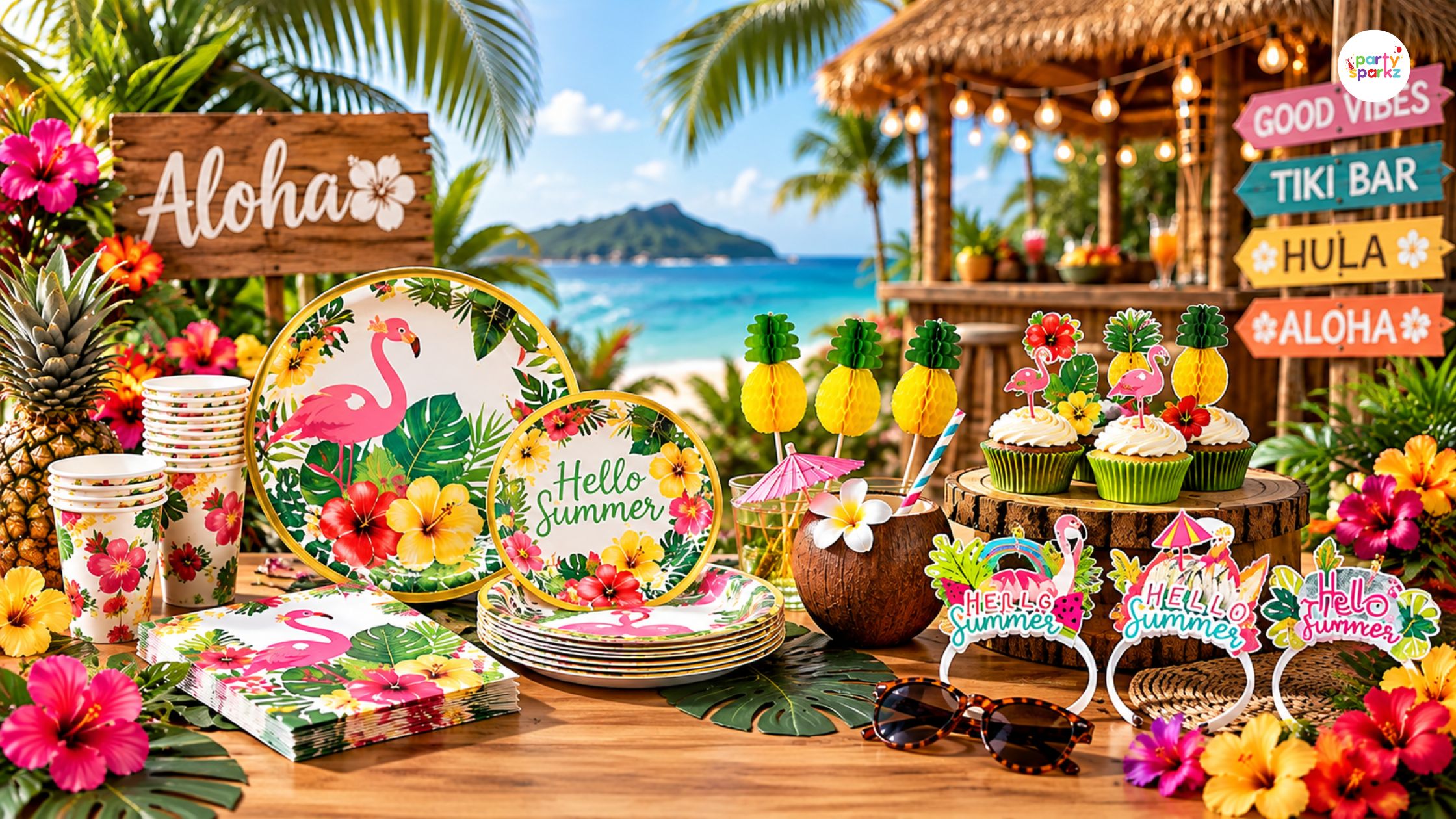
PartySparkz operates as a factory-direct party supply manufacturer supplying wholesale party supplies to global B2B markets. Because the manufacturing relationship is direct rather than through a trading company intermediary, buyers access factory-tier pricing without the quality accountability gap that trading companies introduce. The supply chain documentation necessary for customs clearance and market compliance is part of the normal export process rather than something that has to be requested and chased.
For retailers building a party supply section, factory-direct sourcing through an established supplier means consistent quality specifications across orders — the same paper GSM on the plates, the same latex compound in the balloons, the same print specification on the banners — which is the quality consistency that customer satisfaction and repeat purchase depend on. For event planners who need to be certain that the goods they receive match what they have shown clients in setup photos, consistency between orders is not a preference but a commercial necessity.
Business owners building a resale operation who want to go to market quickly without investing months in supplier development and quality system building have the option to access an already-built manufacturer relationship that covers the full product range. The wholesale party decorations range, latex balloons sourced directly from manufacturing, and the complete event and party supplies wholesale catalogue are accessible without requiring buyers to independently navigate the factory verification and compliance documentation process described in this guide. For hotels and hospitality buyers who need consistent product quality for in-house events and do not have procurement teams with sourcing expertise, this is particularly relevant.
External Resources
International Trade Administration Harmonized System Codes and Supplier Vetting — trade.gov/harmonized-system-hs-codes — the official US government resource on product classification and due diligence frameworks for international buyers.
Intertek Product Testing and Certification for Consumer Goods from China — intertek.com — one of the three major third-party inspection and certification bodies operating in China, covering pre-shipment inspection, lab testing, and compliance certification across all major party supply product categories and markets.
Related reading: Cheapest Way to Import Party Supplies From China | Import Duties on Party Supplies: US, UK, and Australia | Wholesale Party Supplies Manufacturers | Wholesale Party Supplies for Resale | Best Gift Paper Bags for Retailers
The Honest Summary: A Quality Assessment by Category
| Product Category | Typical Quality at Standard Export Tier | Key Risk Factor | Resale Viability |
| Paper plates and napkins | Consistently good | GSM weight divergence from the sample | High — with GSM verification |
| Foil balloons | Good to very good | Colour accuracy across batches | High — with colour specification |
| Latex balloons | Variable | Wall thickness consistency, latex compound quality | Moderate — pre-shipment inflation test essential |
| Paper banners and bunting | Good | Material weight, print registration | High — with weight specification |
| Plastic novelty items | Variable | REACH/CPSC compliance, plastic grade | Moderate — compliance docs essential |
| Fabric accessories (sashes, tablecloths) | Good | Print fastness, fabric weight | High — with print fastness test |
| Hanging and ceiling decorations | Good | Packaging for transit | High — with transit packaging spec |
| LED and light-up accessories | Variable | Battery quality, electrical compliance | Lower — requires electrical compliance verification |
Frequently Asked Questions
Yes, China-made party supplies are resalable — the major global retail chains stock almost nothing else. The outcome depends entirely on which tier of manufacturing you are accessing, which is determined by your due diligence process. Buyers who verify factory status, test samples, specify quality requirements in writing, and use pre-shipment inspection consistently report outcomes they are happy to resell. Buyers who skip these steps and choose on price alone encounter the quality complaints that give the category its mixed reputation.
Accepting the sample as a proxy for production quality without requesting a pre-shipment inspection. The sample is produced under close attention and represents ideal conditions. The production run of 5,000 units runs at speed with different material batches and different quality pressures. Pre-shipment inspection is the mechanism that checks whether the production run actually matches the sample and it is the step most first-time buyers skip in the interest of saving $300 on an order worth $10,000.
For paper tableware in food contact use (EU/UK): a Declaration of Compliance backed by laboratory test reports against EU Regulation 1935/2004. For latex balloons (EU/UK): EN 71-7 test report covering N-nitrosamines and N-nitrosatable substances. For plastic accessories (EU/UK): REACH Annex XVII compliance test report. For the US market: FDA Letter of Guarantee for food contact items, CPSC compliance for any items marketed to or reasonably accessible to children. Always request the laboratory test report alongside any certificate — a certificate without the supporting lab report is not verified compliance evidence.
Ask for the factory’s business licence and compare the company name on the licence to the platform listing name. Request a video call with a factory walkthrough a trading company operating from an office cannot show you production lines. Check whether the supplier’s product range is narrow and specialized (factory) or unusually broad across unrelated categories (trading company). Use China’s National Enterprise Credit Information Publicity System to verify the registered business scope using the supplier’s social credit code. No single test is definitive, but the combined picture makes trading companies identifiable.
At premium export tier factories with documented quality management systems, batch-to-batch variance should be minimal for standard products. At standard export tier factories, minor variation in colour shade, material weight (within 5–10% of specification), and print registration is common and largely unavoidable. This is why specifying tolerances in the purchase order — acceptable ranges rather than exact values is more practically useful than demanding perfect consistency. The variance becomes a problem when it falls outside the tolerance range you specified, which is when you have a documented basis for quality dispute resolution.