
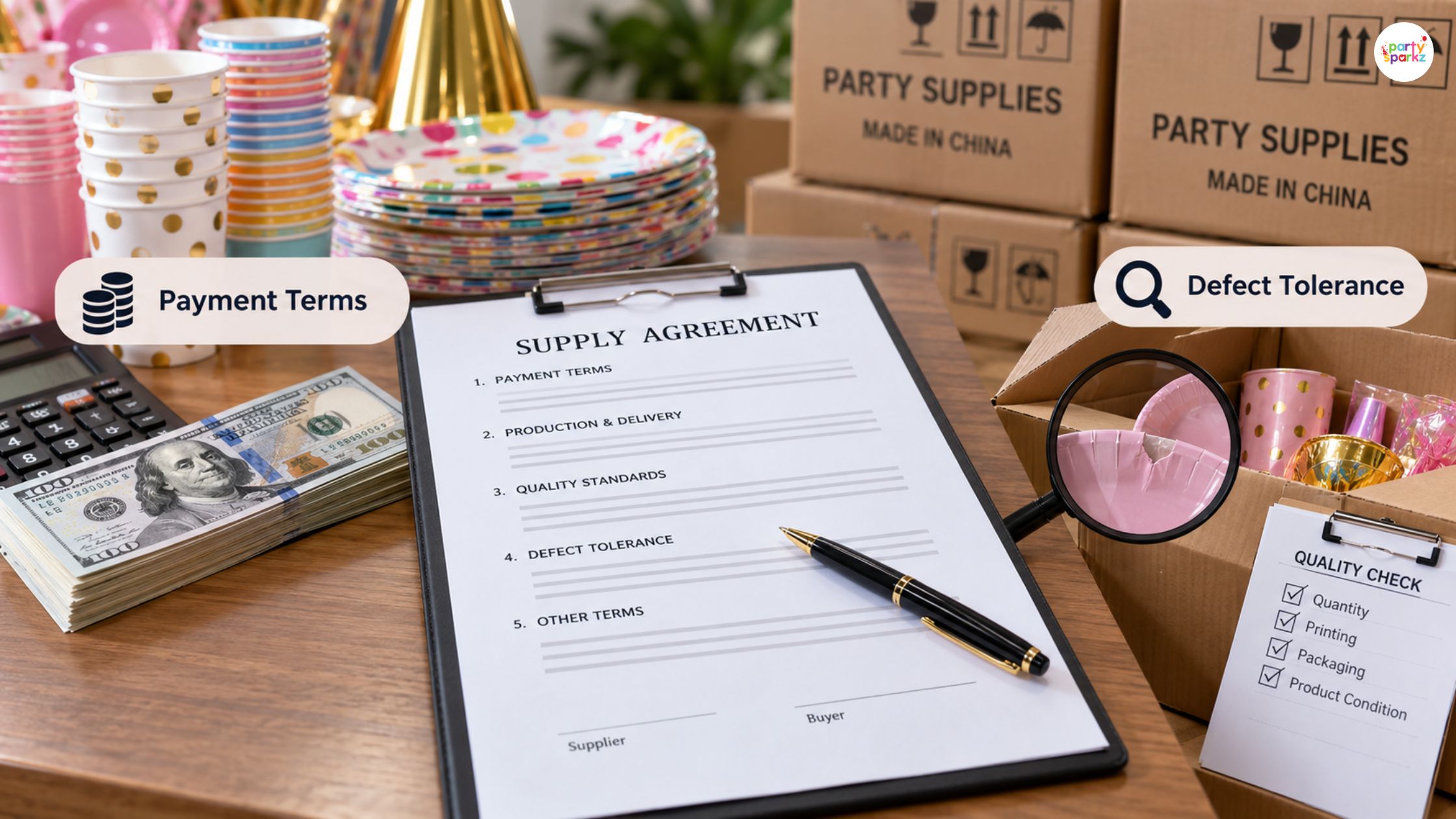
The most important wholesale manufacturer contract terms to negotiate with a wholesale party supplies manufacturer are payment structure (typically a 30% deposit with 70% due before shipment), defect tolerance (defined using an AQL standard like AQL 2.5 under ISO 2859-1), and reorder lead times (which should be specified separately from first-order lead times, since reorder terms are where buyers get surprised most often). Getting these wholesale manufacturer contract terms in writing before production starts, not after a shipment lands, is what separates a smooth manufacturer relationship from a costly dispute.
Here’s a full breakdown of how to negotiate each of these terms, plus the secondary clauses experienced buyers make sure to include.
Table of contents
- Quick Reference: Key Contract Terms to Negotiate
- Payment Terms Wholesale Manufacturer: How to Negotiate Them
- AQL Defect Tolerance Contract Clauses: How to Set Them
- Reorder Lead Time Negotiation and Reorder MOQs
- Other Wholesale Manufacturing Agreement Clauses Worth Including
- Negotiation Approach: Treat It as a Relationship, Not a One-Time Deal
- How This Applies to Party Supplies Manufacturer Contract Negotiation Specifically
- Where to Read More on Contract Negotiation
- Getting Started with a Clearly Structured Wholesale Agreement
- Quick Answer Recap
Quick Reference: Key Contract Terms to Negotiate
| Term | What to Negotiate | Typical Benchmark |
| Payment terms | Deposit percentage, balance timing, payment method | 30% deposit / 70% before shipment (TT); LC for large orders |
| Defect tolerance (AQL) | Inspection standard, acceptable defect rate by severity | AQL 2.5 general, AQL 1.0 for critical defects, under ISO 2859-1 |
| Reorder lead time | Whether reorder lead time differs from first-order lead time | Should be stated separately in writing, not assumed to match |
| Reorder MOQ | Whether reorder MOQ differs from initial order MOQ | Negotiate both explicitly — they’re often not the same |
| Inspection window | Time allowed to reject goods after delivery | 14-30 days from delivery date is standard |
| Remedies for defects | Replacement, rework, or credit — and who pays for re-inspection | Should be explicit, not left to informal negotiation after the fact |
Payment Terms Wholesale Manufacturer: How to Negotiate Them
Payment terms wholesale manufacturer negotiations directly affect a buyer’s working capital, which makes this one of the most consequential — and most negotiable — parts of any manufacturer contract. Every dollar locked into a deposit is a dollar that can’t be used to launch a new product line, fund a marketing push, or cover a slow month, so getting favorable payment terms isn’t just a formality — it has a real impact on cash flow flexibility.
The standard structure for wholesale party supplies manufacturing is a 30/70 payment terms manufacturer split — 30% deposit to initiate production, with the remaining 70% due before shipment — a structure that protects both sides, since the manufacturer has committed capital covered before starting production, and the buyer isn’t paying in full for goods they haven’t yet approved via sample or inspection. For larger orders, a Letter of Credit (LC) is often preferred over a straight TT (telegraphic transfer) arrangement, since an LC provides bank-backed payment security for both parties on higher-value transactions.
Buyers with an established order history can also negotiate extended payment terms over time — a manufacturer more willing to offer flexibility to a buyer with a track record of paying on time and placing recurring orders, since payment reliability is itself a form of leverage in future negotiations. Payment structure and pricing tier are usually negotiated together rather than as separate conversations, so it’s worth reviewing PartySparkz’s published bulk pricing and payment terms alongside whatever structure a manufacturer proposes.
AQL Defect Tolerance Contract Clauses: How to Set Them
Negotiating payment terms without also defining acceptable quality is only solving half the problem. Defective products create downstream costs that often exceed the original manufacturing loss — returns, refunds, damaged customer relationships, and stranded inventory — which is exactly why an AQL defect tolerance contract clause needs to be written into the agreement before production starts, not negotiated after a shipment already lands at the warehouse.
AQL (Acceptable Quality Limit) is the standard framework most quality inspections are built around, typically referencing the sampling methodology in ISO 2859-1 (and its US equivalent, ANSI/ASQ Z1.4), which set sample sizes and acceptance thresholds for lot-by-lot inspection. Rather than drafting bespoke, ad hoc quality criteria, most experienced buyers applying the ISO 2859-1 AQL standard to party supplies specifically name a recognized reference point — for example, “ISO 2859-1, AQL 1.5” — since internationally recognized standards are easier to apply consistently and harder for either party to dispute later.
For general consumer products like party supplies, Inspection Level II is the widely used default, with AQL reference points commonly set at:
- AQL 1.0 for critical defects (safety-related issues — particularly important for products marketed to or used by children)
- AQL 2.5 for major defects (functional or clearly visible quality problems)
- AQL 4.0 for minor defects (small cosmetic imperfections that don’t affect function)
Beyond setting the AQL threshold itself, the contract should also specify: the inspection window after delivery during which the buyer can reject goods (14-30 days from the delivery date is standard), what remedy applies to non-conforming goods (replacement, rework, or credit), and who bears the cost of re-inspection if a dispute arises over whether the defect rate was actually exceeded. Buyers sourcing children’s party products specifically should pay close attention to how critical-defect AQL thresholds are defined, given the safety stakes involved — worth negotiating explicitly with any wholesale party supplies manufacturer rather than accepting a generic default.
Also read – partysparkz shipping and delivery
Reorder Lead Time Negotiation and Reorder MOQs
Reorder lead time negotiation is where many buyers get caught off guard, precisely because the friction shows up after the relationship is already established — not during the initial sales conversation, when a manufacturer is naturally more flexible to win the business.
A few specific reorder-term issues consistently trip up buyers:
- MOQ is only listed in quotations, not fixed in the written supply agreement — meaning it can shift between the first order and a reorder without formal notice.
- MOQ differs between standard products and reorder batches, or resets entirely if custom logo, labeling, or private packaging is involved, since a “clean” reorder of an already-produced design and a request with new customization are treated as different production runs.
- Vague lead time language — wording like “about 30 days” rather than a firm, contractually stated reorder lead time — creates planning uncertainty that a fixed-quantity clause would prevent.
- Mixed-SKU replenishment isn’t allowed within a single production batch, forcing buyers to either overstock slow-moving inventory just to hit a reorder minimum on one fast-moving item, or place several smaller, less efficient orders instead.
The practical fix recommended across sourcing guidance is to negotiate reorder MOQ wholesale manufacturer terms as two separate MOQ structures explicitly — an initial order MOQ and a distinct reorder MOQ — rather than assuming the first order’s terms will automatically carry forward. Buyers should also confirm upfront whether mixed cartons, mixed colors, or mixed-SKU assortments are accepted within a single reorder batch, since this flexibility can be the difference between healthy inventory turnover and dead stock accumulation for categories with many seasonal or themed SKUs.
Other Wholesale Manufacturing Agreement Clauses Worth Including
Beyond the three core terms above, a handful of secondary wholesale manufacturing agreement clauses are worth negotiating explicitly rather than leaving to informal understanding:
- Detailed technical specifications with measurable tolerances. Vague product descriptions create disputes, since there’s no objective standard to measure a defective shipment against — attach a specification schedule covering materials, dimensions, tolerances, and reference photos, and require written amendment if specs change.
- IP protection, particularly for custom or private-label designs, since inadequate IP clauses can allow a design to be quietly reproduced or resold by the manufacturer to other buyers.
- Termination and exit terms, including a reasonable notice period (typically 30-90 days) rather than an open-ended commitment with no clear exit path.
- Tooling ownership, for buyers funding custom molds or production tooling — the contract should explicitly state that buyer-funded tooling is buyer property, since manufacturers have in some cases withheld buyer-funded molds pending resolution of a disputed invoice.
- Price change terms, particularly for raw-material-driven price fluctuations, so a buyer isn’t caught by an unexpected reorder price increase without agreed limits on how much or how often pricing can shift.
Negotiation Approach: Treat It as a Relationship, Not a One-Time Deal
The most effective negotiating buyers don’t treat these terms as a single adversarial negotiation to win once — they treat the relationship as ongoing leverage. A few practices consistently show up among buyers who negotiate the most favorable long-term terms:
- Visit the factory in person or conduct a virtual inspection to establish trust before finalizing terms, since manufacturers are generally more willing to extend flexibility to buyers who’ve demonstrated genuine engagement with the relationship.
- Pay on time, every time. Payment reliability directly affects a manufacturer’s willingness to offer better terms — extended payment windows, priority production scheduling, lower reorder MOQs — on future orders.
- Show long-term growth potential. Manufacturers are more willing to invest additional flexibility and attention in buyers who represent future volume, not just a single transaction.
- Get everything in writing. Once terms are finalized, don’t rely on a handshake agreement or a loose email thread — a formal written agreement is what actually protects both parties if a dispute arises later.
Also read – factory direct party supplies manufacturer
How This Applies to Party Supplies Manufacturer Contract Negotiation Specifically
Party supplies manufacturer contract negotiation carries a few category-specific considerations worth folding in: seasonal SKUs make the reorder-MOQ and mixed-SKU flexibility points especially relevant, since a retailer reordering ahead of Halloween or Christmas often needs a mixed assortment rather than a single-SKU bulk batch; children’s product categories make the AQL critical-defect threshold worth negotiating carefully rather than accepting a generic default; and custom-branded or private-label orders make the IP and specification-schedule clauses genuinely important given how much design work goes into a coordinated party supplies line.
Buyers comparing manufacturers on these terms specifically should review how wholesale party supplies manufacturers structure payment and MOQ terms, and should ask about the sample approval process specifically — sample sign-off is where design, materials, and specifications actually get finalized before mass production begins, and it should be treated as part of the same contract negotiation timeline rather than an afterthought.
Where to Read More on Contract Negotiation
Two resources worth reviewing for a deeper breakdown of these terms beyond party supplies specifically:
- Prosper’s guide to negotiating payment terms and defect rates with overseas manufacturers covers how to write an AQL 2.5 defect-rate clause in more technical detail, along with how pre-shipment inspections fit into the payment release process.
- Business-in-a-Box’s manufacturing agreement template guide walks through the specification schedule, tooling ownership, and inspection window clauses in more depth, with practical examples of how each clause should be worded.
Getting Started with a Clearly Structured Wholesale Agreement
Buyers evaluating a new manufacturer relationship can review PartySparkz’s wholesale party supplies program for how payment terms, MOQs, and sample processes are structured from the outset, or start with wholesale party supplies for business owners’ guidance for help preparing the right questions before a first contract negotiation.
Quick Answer Recap
The three most consequential terms to negotiate with a wholesale party supplies manufacturer are payment structure (commonly 30% deposit / 70% before shipment, or LC for large orders), defect tolerance defined through a named AQL standard (AQL 2.5 general, AQL 1.0 for critical/safety defects), and reorder lead times and MOQs specified separately in writing from first-order terms. Buyers who negotiate these three terms explicitly — plus secondary clauses covering specifications, IP protection, and tooling ownership — avoid the majority of disputes that arise from assuming informal or first-order terms will automatically carry forward to future orders.