
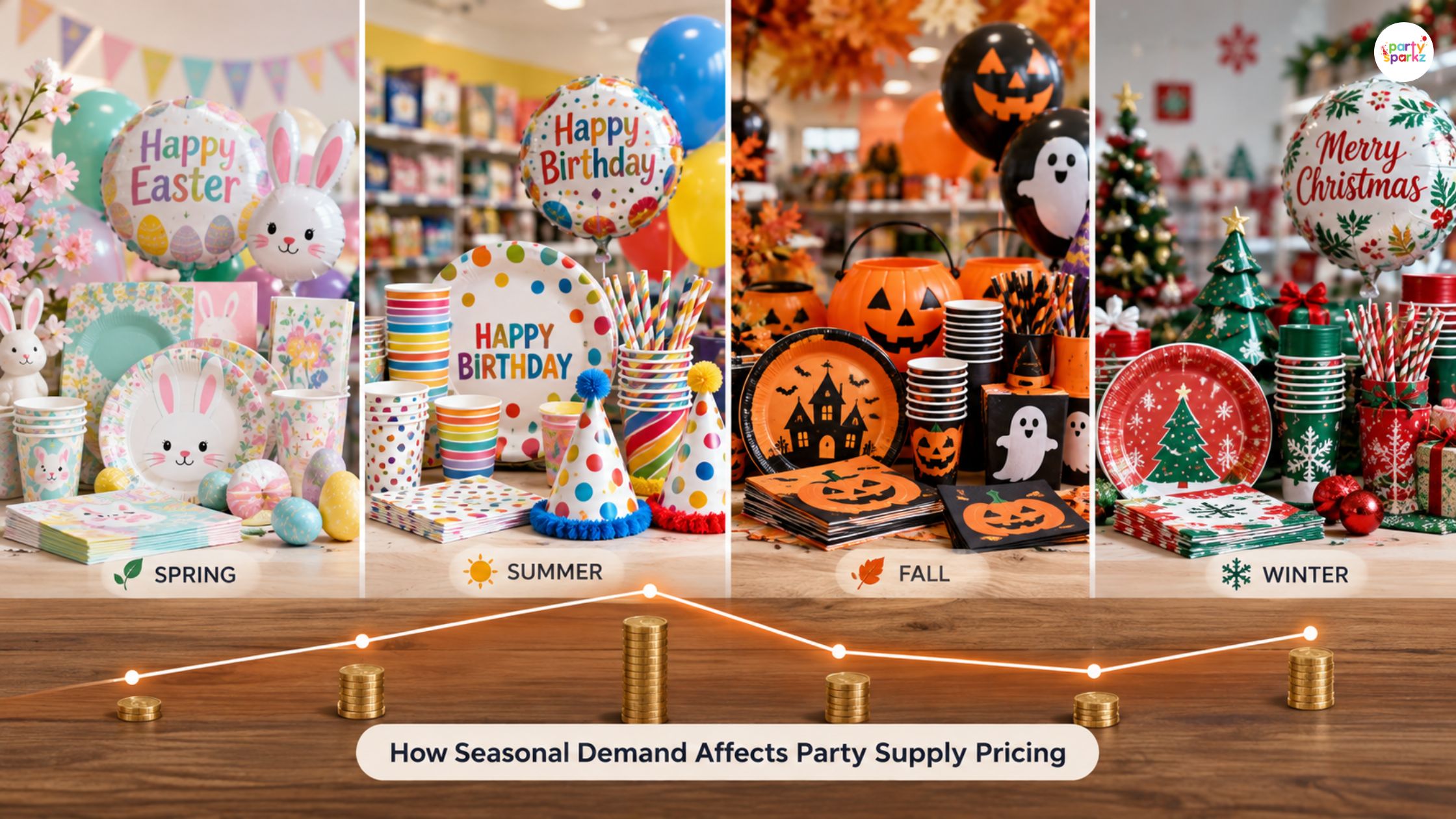
Seasonal Demand Affects Party Supply Pricing drives both freight costs and factory lead times up sharply for party supplies, since the industry’s biggest occasions, Halloween and Christmas, fall directly inside the same peak shipping window that every other consumer goods category is competing for. Ocean freight peak season surcharges (PSS) commonly run $300-1,000 per container in 2026, spiking as high as $2,000 in unusually tight periods, while factory lead times stretch as production capacity gets allocated to whichever buyers committed earliest. Retailers who order on the same timeline every year, without adjusting for this compounding seasonal pressure, consistently pay more and receive less reliable delivery than those who plan around it.
Here’s exactly how seasonal demand moves pricing and lead times across the party supplies calendar, and what that means for order timing.
Table of contents
- The Peak Season Calendar That Affects Party Supplies
- Why Factory Lead Times Stretch During Peak Season
- Why Freight Costs Spike During Peak Season
- How This Compounds Specifically for Party Supplies
- Practical Order Timing to Manage Seasonal Pricing and Lead Time Risk
- How Retailers Can Protect Margins Against Seasonal Pricing Swings
- Applying This to Your Sourcing Calendar
- Where to Read More on Peak Season Logistics
- Getting Ahead of Seasonal Pricing Pressure
- Quick Answer Recap
The Peak Season Calendar That Affects Party Supplies
| Peak Period | Approximate Window (2026) | What It Affects |
| Chinese New Year (CNY) factory shutdown | Late December ramp-down, 2-3 week closure, gradual ramp to mid-March | Factory production capacity and lead times |
| Ocean freight peak season | June through October/November | Container freight rates, PSS charges |
| Air freight peak season | August through December | Air freight rates for urgent/lightweight orders |
| Parcel carrier peak season | Early/mid-October through mid-January | Last-mile and e-commerce shipping surcharges |
| Party supplies retail demand peak | September (Halloween prep) through December (Christmas/New Year) | Directly overlaps with every freight peak window above |
The core problem for party supply retailers is structural: the industry’s two biggest occasions, Halloween and Christmas, land squarely inside the same months when ocean freight, air freight, and parcel carriers are all simultaneously running peak surcharges. Unlike categories with demand spread more evenly across the year, party supplies retailers face compounding cost pressure exactly when they need to be ordering the most inventory.
Why Factory Lead Times Stretch During Peak Season
Lead time increases during peak season come from two separate mechanisms, and understanding both matters for planning:
Production capacity gets allocated to whoever commits first. Factories operate with finite production capacity, and during high-demand periods, that capacity gets booked by the buyers who place orders earliest — not necessarily the buyers offering the best price. A retailer placing a Halloween order in August is competing for factory slots against every other buyer in every other consumer goods category also trying to hit a Q4 deadline, which is exactly why experienced buyers place custom seasonal orders months ahead of when the product will actually retail.
Chinese New Year creates an annual capacity cliff. While the official CNY holiday spans about one week, the practical production impact extends across 8-10 weeks, as factories ramp down output in late December, close entirely for 2-3 weeks, and then gradually return to full capacity through mid-March. This directly affects the timeline for Valentine’s Day and early spring seasonal orders, since factories are recovering from the CNY disruption at exactly the point buyers need product moving for late-winter and early-spring occasions.
Also read – wholesale manufacturer contract terms
Why Freight Costs Spike During Peak Season
Peak Season Surcharges (PSS) are temporary fees carriers add on top of base shipping rates specifically to manage capacity constraints during high-demand periods, and 2026 data shows these charges have real, material impact on landed cost:
- Ocean freight PSS on trans-Pacific lanes commonly runs $300-1,000 per FEU (40-foot container) during announced peak windows, though 2026 saw charges spike as high as $2,000 per FEU during an unusually tight period in June, driven by tariff-related front-loading that pulled the peak season earlier than its historical pattern.
- Parcel carrier demand surcharges have climbed consistently for several years running — one major carrier’s 2026 holiday-peak surcharge rose 23% year-over-year, part of a pattern that’s pushed the cost of shipping the same package during peak week up nearly 60% over two years.
- The peak window itself has been shifting earlier. In 2026, tariff-driven front-loading caused carriers to announce PSS charges and general rate increases roughly a month earlier than the historical pattern, meaning retailers planning around “last year’s timing” are increasingly planning against a moving target.
For party supply retailers specifically, this means the cost of shipping a Halloween or Christmas order isn’t fixed simply by locking in a supplier price — freight cost is a separate, volatile variable that can shift the total landed cost significantly between when a quote is requested and when the container actually ships, particularly for orders placed close to the peak window rather than well ahead of it.
How This Compounds Specifically for Party Supplies
A few dynamics make seasonal pricing pressure hit party supplies retailers harder than some other categories:
Multiple occasions cluster inside the same freight peak window. Halloween (October) and Christmas (December) both fall inside the ocean and parcel freight peak windows, meaning a retailer stocking both seasons is exposed to peak surcharges twice in close succession, with limited off-peak breathing room between them.
Valentine’s Day lands right after the CNY recovery period. Since factories are still ramping back to full capacity through mid-March following Chinese New Year, and Valentine’s Day inventory needs to ship well before mid-February, this occasion sits in a genuinely tight production window — core wholesale orders for Valentine’s Day are generally recommended by early December, well before the CNY disruption even begins, specifically to avoid this squeeze. Given that Valentine’s Day 2026 consumer spending is forecast to reach a record $29.1 billion, retailers who miss this ordering window aren’t just facing tighter lead times — they’re missing a genuinely large demand spike.
Custom and private-label orders are hit hardest. A generic, in-stock product can sometimes be pulled from existing inventory even during peak season, but a custom-printed or private-label order requires a dedicated production slot — exactly the capacity that gets booked first and becomes scarce as peak season approaches.
Also read – libaba vs direct factory sourcing
Practical Order Timing to Manage Seasonal Pricing and Lead Time Risk
The consistent theme across sourcing guidance is that order timing, not just supplier selection, is what actually controls exposure to seasonal pricing and lead-time risk:
- For Christmas products, most experienced buyers place custom orders in July or August specifically to secure production slots before the peak season crunch — leaving custom orders until September for a November delivery is considered high-risk given how quickly capacity fills.
- For Halloween, ordering needs to happen early enough that both the production run and the ocean freight peak surcharge window (which starts as early as June) are already factored into the timeline, not treated as a September decision.
- For Valentine’s Day, core wholesale orders should be placed by early December, ahead of the CNY production slowdown, with smaller top-up orders possible into mid-January once factories have partially recovered.
- For less time-critical, evergreen categories like standard balloons and tableware, off-peak ordering (outside the June-January freight peak window) captures meaningfully lower shipping costs, making it worth building extra buffer stock during quieter months rather than reordering reactively closer to a seasonal deadline.
Retailers can review a fuller month-by-month breakdown of seasonal ordering windows and demand data across the full party supplies calendar in Best-Selling Seasonal Party Products by Month, which covers specific order-by timing for each major occasion in more depth than covered here.
How Retailers Can Protect Margins Against Seasonal Pricing Swings
A few practical strategies reduce exposure to the pricing and lead-time volatility described above:
- Lock in supplier and freight commitments during Q1-Q2, well before peak season surcharges are announced, rather than negotiating fresh terms once the market has already tightened.
- Consider DDP (Delivered Duty Paid) shipping terms for peak-season orders specifically, since a fixed landed price removes the risk of an unexpected freight surcharge eating into margin between quote and shipment.
- Diversify order timing across evergreen and seasonal SKUs, so not all inventory is competing for the same tight production and freight windows — a strategy covered in more depth in guidance on how many SKUs a new party supply retailer should stock, where sequencing evergreen versus seasonal orders is a core planning principle.
- Build a working relationship with a factory-direct manufacturer rather than a trading company, since factory-direct buyers with an established order history generally get priority production scheduling during peak season — a benefit trading company customers, who are competing with every other buyer the trading company sources for, typically don’t receive to the same degree.
Also read – DIY Balloon Arch vs Buying a Kit
Applying This to Your Sourcing Calendar
Retailers planning for Halloween party supplies or Christmas party supplies should treat production lead time and freight peak windows as two separate variables to plan around, not a single combined estimate — a manufacturer’s stated production lead time typically doesn’t already include the freight peak surcharge and capacity risk layered on top during Q4. Buyers sourcing through wholesale party supplies manufacturers should ask specifically how a supplier prioritizes production scheduling during peak season, since this is exactly where the practical difference between a factory-direct relationship and a trading company intermediary shows up most clearly.
Where to Read More on Peak Season Logistics
Two current sources worth reviewing for a deeper breakdown of the freight side of this seasonal pricing pattern:
- Maersk’s 2026 Peak Periods in Logistics guide covers all five major global peak logistics periods for 2026, including how Chinese New Year and Golden Week disrupt production and shipping schedules well beyond their official holiday dates.
- GoFreight’s 2026 carrier peak season surcharge guide breaks down exact PSS pricing ranges by trade lane and carrier, useful for benchmarking a freight quote against current market rates before committing to a shipping date.
Getting Ahead of Seasonal Pricing Pressure
Retailers wanting to lock in production capacity and pricing ahead of the next peak season can review current lead times and MOQs through PartySparkz’s wholesale party supplies catalog, or work directly with the team to plan a seasonal order calendar that accounts for both production scheduling and freight timing rather than reacting to each seasonal deadline individually.
Quick Answer Recap
Seasonal demand affects party supply pricing and lead times through two compounding mechanisms: factory production capacity gets allocated to earliest-committing buyers, and freight peak season surcharges (commonly $300-1,000 per container, occasionally spiking to $2,000) apply directly across the same months — June through January — when Halloween and Christmas inventory needs to ship. Valentine’s Day carries its own distinct risk, landing right after the Chinese New Year production slowdown that extends 8-10 weeks beyond the official holiday. Retailers who lock in orders during Q1-Q2, build relationships with factory-direct manufacturers, and separate evergreen from seasonal ordering timelines consistently avoid the worst of both the pricing and lead-time pressure that hits reactive, late-ordering retailers every peak season.